


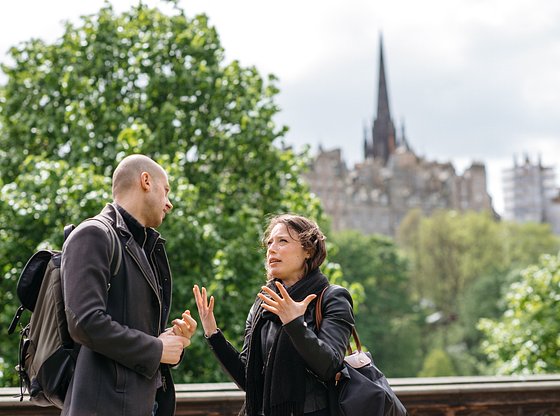








Jenny did a great job - focus was on a limited historical area and easy to navigate in the short time frame we had. She pivoted us away from overbearing crowds and shared some great recommendations for restaurants and shopping.

Edinburgh Tours
Expert-led Edinburgh walking tours that turn medieval streets and Enlightenment ideas into meaningful discoveries
Let Your Curiosity Shape Your Journey
Join passionate experts on intimate walking tours that reveal a city's unique stories, spark conversations, and leave you seeing the world—and yourself—a little differently.
Experts, not guides
Explore with 1,200+ Experts, from historians and architects to chefs and archaeologists.
Crafted for conversation
With fewer than ten guests, engage your Expert through questions and immerse fully.
Structured, never scripted
Your interests guide your Expert, leading to stories and perspectives that matter to you.
Curious or connoisseur
First-time visitor or seasoned explorer, our tours span city highlights to deep-dives.
Edinburgh, Seen with Context
Edinburgh isn’t just a castle above the skyline. Walk with an expert to discover how writers, philosophers, and reformers shaped Scotland’s remarkable capital.

Find your perfect pair this summer
Save 10% when you book 2 or more tours.
Hear from our customers
Sandra was marvelous and made our tour so enjoyable. She tailored our tour to our questions and experience and showed us parts of Edinburgh we would never have found or seen on our own. Super friendly, knowledgeable, and so pleasant to spend the afternoon with. Highly recommended!
Jane was excellent.
Edinburgh Tours
Edinburgh is a city of contrasts. Medieval closes climb toward the castle. Georgian streets unfold with Enlightenment order. Stories of monarchy, rebellion, literature, science, food, and folklore all sit close together, sometimes on the same steep walk.
The challenge is not finding history in Edinburgh. It is understanding which version of the city you are seeing.
The right tour helps connect the Old Town, New Town, museums, neighborhoods, and surrounding landscapes into a fuller story of Scotland’s capital.
Best for First-Time Visitors
If it’s your first time in Edinburgh, begin with an experience that introduces both the Old Town and the city’s wider historical importance.
These tours help travelers understand how Edinburgh developed from a medieval stronghold into a center of politics, learning, literature, and Scottish identity.
Best for Day Trips from Edinburgh
Some of Scotland’s defining landscapes and stories sit just beyond the city.
These experiences expand the story of Scotland through castles, universities, coastlines, royal history, and Highland landscapes.
Best for Flexible, Self-Guided Exploration
For travelers who prefer independence:
These options offer expert insight while allowing travelers to explore at their own pace.
Edinburgh rises between volcanic hills and the North Sea, a city where medieval streets, Enlightenment ideals, and modern Scottish identity intersect. First established as a royal stronghold around Edinburgh Castle, the city grew along the Royal Mile before expanding in the 18th century with the elegant Georgian planning of the New Town.
For centuries, Edinburgh served as Scotland’s political and intellectual center. During the Scottish Enlightenment, philosophers, scientists, and writers transformed the city into one of Europe’s most influential centers of learning. Today, travelers come to Edinburgh for its historic architecture, literary traditions, and dramatic landscape. Context Travel’s Edinburgh tours are led by historians and cultural experts who help travelers understand how the city’s castles, streets, and institutions shaped Scotland’s history.
Edinburgh is known for its medieval Old Town, Enlightenment heritage, and role as Scotland’s historic capital.
Edinburgh Castle and Royal History
Perched atop Castle Rock, Edinburgh Castle has served as a royal residence, military fortress, and symbol of Scottish identity for centuries.
The Royal Mile and Medieval Old Town
The Royal Mile connects Edinburgh Castle to the Palace of Holyroodhouse, lined with historic buildings, closes, and institutions that reveal the city’s medieval past.
The Scottish Enlightenment
During the 18th century, Edinburgh became one of Europe’s most important intellectual centers, producing thinkers such as David Hume and Adam Smith.
Georgian New Town
Built in the late 18th century, the New Town reflects Enlightenment ideals of order, symmetry, and urban planning.
Literary Heritage
Edinburgh has long been associated with writers such as Sir Walter Scott and Robert Louis Stevenson and today holds UNESCO City of Literature status.
Edinburgh appeals to travelers interested in history, literature, and political heritage. First-time visitors benefit from guided introductions to the Royal Mile and Edinburgh Castle to understand the city’s medieval origins and royal past. Lifelong learners are drawn to the intellectual legacy of the Scottish Enlightenment and the city’s literary traditions, while repeat visitors often explore neighborhoods, museums, and cultural institutions that reveal deeper layers of Scottish identity.
Edinburgh’s historic center is compact and well-suited to walking tours, though the city’s hills and cobbled streets can make some routes steep. Many major landmarks, including Edinburgh Castle, the Royal Mile, and Holyrood Palace, are located within walking distance of one another.
Most travelers spend two to three days exploring Edinburgh’s historic sites, museums, and surrounding viewpoints. August is a particularly lively time to visit during the Edinburgh Festival Fringe, while spring and early autumn offer comfortable weather for walking tours.
English is the primary language spoken in Edinburgh, and Scotland uses the British pound (£) as its currency.
For many travelers, it comes down to how they want to understand Edinburgh.
It is possible to walk the Royal Mile, visit the castle area, and explore museums independently. But Edinburgh’s deeper story is not always obvious. A narrow close may reveal centuries of overcrowding and social change. A Georgian square can speak to Enlightenment ambition. A literary reference may carry political meaning. Even the city’s ghost stories often point toward real histories of fear, medicine, poverty, and belief.
Context Travel’s Edinburgh tours are designed to bring those connections into focus.
Led by historians, literary scholars, food specialists, local experts, and family-friendly guides, our tours help travelers understand how Edinburgh became a capital of monarchy, rebellion, science, literature, and Scottish identity. Whether you’re walking the Royal Mile, studying Georgian New Town, tasting Scottish food, or exploring the Highlands beyond the city, the goal is not simply to see Edinburgh, but to understand what shaped it.
We offer several ways to explore depending on your travel style:
- Audio guides for independent travelers (starting around $20)
- Small group walking tours (starting around $141 per person)
- Private tours for more flexibility and deeper discussion (starting around $500+)
If you want to move beyond Edinburgh’s dramatic views and experience the city with more historical, cultural, and human depth, many travelers find Context’s expert-led tours well worth it.
What is Edinburgh known for?
Edinburgh is known for its historic castle, medieval Old Town, Georgian New Town, and its role in the Scottish Enlightenment.
Is Edinburgh worth visiting?
Yes. Edinburgh offers a rich mix of history, architecture, literature, and dramatic landscapes that make it one of Europe’s most distinctive capitals.
How many days should you spend in Edinburgh?
Most travelers spend two to three days exploring Edinburgh’s historic sites, museums, and surrounding viewpoints.
Is Edinburgh walkable?
Yes. Edinburgh’s historic center is compact and ideal for walking tours, though the terrain includes hills and cobblestone streets.
Why is Edinburgh important historically?
Edinburgh served as Scotland’s political and intellectual center for centuries and played a major role in the Scottish Enlightenment.
When is the best time to visit Edinburgh?
Spring and early autumn offer pleasant weather, while August hosts the world-famous Edinburgh Festival Fringe.