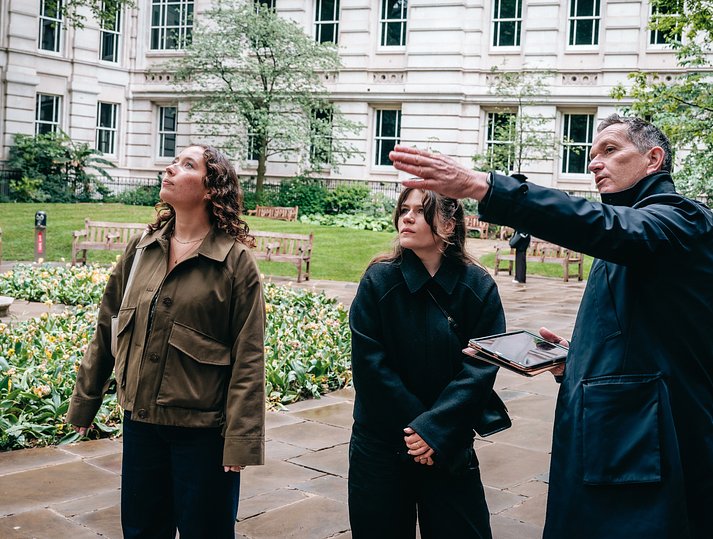
Mark was a fantastic tour guide.

Westminster Abbey Tour: Church, Crown & Memory
Understand where faith, monarchy, and tradition meet
Trace Britain’s culture, history, and collective memory through one of its famous churches, where architecture (and even graves) bring the past alive.
Tour Highlights
- A complete look at the Abbey Move beyond surface history to uncover symbols, stories, and meanings within ritual and belief.
- Poets, thinkers, and icons See how vaunted writers, scientists, monarchs, and statesmen are remembered together under one roof.
- Royal beginnings and burials Understand how coronations, weddings, and funerals are intertwined with national identity.
- Overlooked details others miss Learn how to spot the moments that reveal personal stories hidden within the grand narrative.
- Connect history to today Explore how faith, creativity, and power intersect in monuments that still influence public life.
Led by Experts, Shaped by You
Explore with an expert guide who responds to your questions, your interests, and your pace. Reveal layers of meaning most visitors miss—go from seeing to understanding.


The Finer Details
Westminster Abbey is more than a church. It is a remarkable record of how Britain remembers itself shown in stone and ritual. Step inside with an Expert who helps translate what this architecturally ornate building reveals about power, faith, and identity in the United Kingdom.
Begin your Westminster Abbey tour by exploring the evolution of the site from simple marshland by the River Thames to a key landmark of royal and parliamentary power, and discover how the Abbey’s architecture and evolving design have reflected the country’s priorities over its 1000-year history. Discuss why certain styles were chosen and how symbolism guided everything from height to light. What does the building ask visitors to feel?
Begin your Westminster Abbey tour by exploring the evolution of the site from simple marshland by the River Thames to a key landmark of royal and parliamentary power, and discover how the Abbey’s architecture and evolving design have reflected the country’s priorities over its 1000-year history. Discuss why certain styles were chosen and how symbolism guided everything from height to light. What does the building ask visitors to feel?
Move through royal tombs that trace centuries of British monarchy, from Edward the Confessor to Elizabeth I. Question your Expert to learn how each of these kings and queens left their mark on the building and the country, and find out why more modern monarchs have chosen to be buried elsewhere.
Enter Poets’ Corner where writers and thinkers rest together in conversation across generations; the words of literary legends like Geoffrey Chaucer, Charles Dickens, and Lord Alfred Tennyson seem as at home here as the Bible. Carry on in your journey in the shadows of Sir Isaac Newton, Charles Darwin, and Stephen Hawking and consider why poets, scientists, and statesmen share this space. How did words, ideas, and discoveries define national memory? And why is all this worldliness remembered in a spiritual setting?
Looking to today, examine the coronations and state ceremonies that still unfold at this UNESCO World Heritage site. With the help of your Expert, you’ll better understand how royal and religious ritual transforms the building into a stage for power and continuity through traditions that connect medieval belief to an evolving idea of modern identity.
Throughout your visit, take time to pause in quieter corners often overlooked by visitors, where small details reveal personal stories, private devotion, and artistic choices that complicate the grand narrative. Leave with a deeper sense of how Britain’s past still shapes its present.
Meet the Experts

















































%20-%202026-05-18T122730.868.png)
Where You’ll Go
From iconic landmarks to tucked-away local favorites, these are the places you’ll explore and experience firsthand with your Expert.
-
Westminster AbbeyGothic abbey in London, traditional site for coronations and royal ceremonies.
What’s Included As Standard
Here’s a look at what your tour covers, plus anything you’ll want to consider arranging separately, so you can plan with confidence.
Included
-
English-speaking expert guideTours led in English, offering you unbroken understanding throughout.
-
Intentionally sized groupsA smaller group means more time for conversations and questions.
-
Tickets and entrance feesAll entry tickets included.
Not Included
-
GratuitiesTips aren’t included, but we encourage tipping as a way to thank your guide after your experience.
-
Food and drinkFood and drink are not included, but your expert can provide recommendations for after the tour.
-
Transportation to and from the meeting pointTransportation is not included. Pre- and/or post-transit can be added to some tours by request.
-
Hotel pickup or drop-offTravel to or from accommodation isn’t included; however, this service can be added by request.
Where You'll Explore
Make the Most of Your Tour
Some helpful advice for getting the most from your experience, from practical prep to small on-the-day tips.
Dos:
- Wear comfortable footwear
- Check the weather and dress appropriately
- Bring a bottle of water (no glass)
- Feel free to ask your Expert anything
Don'ts:
- Bring firearms or weapons
- Bring sharp objects (e.g. knives, swiss army knives, switchblades, hiking sticks)
- Dress inappropriately to enter religious sites or sacred monuments
Any questions? You can always
contact us.
Frequently Asked Questions
Book with confidence — see Context's flexible cancellation policy here.
Absolutely! We offer family-friendly guides adept at engaging children. To enhance their experience, share details about your children's interests, hobbies, or favorite school subjects, so we can pair you with the most fitting guide.
As an active place of worship, modest attire is recommended. Shoulders and knees should be covered when possible. Comfortable shoes are advised due to stone floors and extended standing.
We understand that some of our valued guests may have mobility concerns, and we want to ensure you have a comfortable and enjoyable experience throughout your tour. If there are any accessibility concerns that your tour guide will need to be aware of, please let our team know at the time of booking.
- Many of the main areas of the Abbey, including the Nave, Quire, and Cloisters, are accessible to wheelchair users. Step-free access is available via the North Door (Great North Door). This entrance is equipped with a ramp.
- Due to the Abbey’s historic architecture, some areas have limited access. In particular, the Queen’s Diamond Jubilee Galleries are not accessible to wheelchair users, as access is via stairs. Additionally, certain chapels and spaces may have small steps or uneven flooring.
- For the most up-to-date and detailed accessibility information, we recommend checking the official Westminster Abbey website or contacting the Abbey directly before your visit to ensure a smooth and comfortable experience.
- Please let us know if you will be using a wheelchair on our tour so that we can plan the most accessible route for you.
Service Animals
- Assistance dogs are welcome at Westminster Abbey. They must be clearly identifiable as working dogs (for example, wearing a harness or jacket) and remain under control at all times.
- If you will be visiting with an assistance dog, please inform us in advance so we can provide any additional guidance to help make your visit as seamless as possible.
Don’t just take our word for it
Janice was excellent and provided a tremendous amount of information but still kept it to a personal level
Just Brilliant. A superb tour of Westminster Abbey. Why? Imogen was extremely knowledgeable and communicative not only of the physical elements of/in the Church but of their back stories, meanings and impacts. Imogene in her presentations by providing historical references and scenes was able to provide context for what we were seeing and for our understanding of again not only what we observed but also for various events of English life and individuals that are in or related to the Abbey. And to put it very simply and directly, Imogen is an extremely nice person who was very attentive to us and our needs.
Let Your Curiosity Shape Your Journey
Join passionate experts on intimate walking tours that reveal a city’s unique stories, spark conversations, and leave you seeing the world—and yourself—a little differently.
Structured, never scripted
Your interests guide your Expert, leading to stories and perspectives that matter to you.
Crafted for conversation
With 12 or fewer guests, ask questions, engage with your Expert, and fully immerse yourself.
Experts, not guides
Explore with 1,200+ Experts—from historians and architects to archaeologists and chefs.
Related experiences our customers also loved


Westminster Abbey Tour
Westminster Abbey is not simply a royal church. It is a place where Britain has repeatedly decided how power should be celebrated, who should be remembered, and which traditions should endure. On this Westminster Abbey tour, a historian helps connect coronations, royal tombs, Poets’ Corner, architecture, and religious ritual into a larger story about national identity. The building has served as Britain’s coronation church since 1066, while more than 3,300 people are buried or commemorated within it. That combination makes the Abbey unusual. It is at once a working church, royal ceremonial space, burial ground, architectural monument, and record of how Britain has chosen to remember monarchs, writers, scientists, politicians, and public figures. The value of a guided visit is therefore not simply identifying famous graves. It is understanding why these people, rituals, and monuments were placed together under one roof.
Westminster Abbey has been the setting for royal coronations since William the Conqueror was crowned there on Christmas Day in 1066. King Charles III became the 40th reigning monarch to be crowned at the Abbey in 2023.
That continuity matters because a coronation is more than a public spectacle. It is a ritual through which monarchy is presented as legitimate, sacred, historical, and continuous. The building itself reinforces that message.
Royal tombs connect successive dynasties. The high altar frames the most solemn ceremonial moments. The Coronation Chair, commissioned by Edward I around 1300, has been central to coronation ceremonies for more than 700 years.
Seen together, these elements turn architecture and objects into instruments of political memory. The Abbey does not simply record monarchy. It helps stage it.
Seen together, these elements turn architecture and objects into instruments of political memory. The Abbey does not simply record monarchy. It helps stage it.
Westminster Abbey gradually became a place of national memory as well as royal worship. That is why a visitor can move from medieval kings to Geoffrey Chaucer, Charles Dickens, Isaac Newton, Charles Darwin, and Stephen Hawking within the same building. The live tour uses these juxtapositions to ask why writers, scientists, rulers, and public figures came to share the same commemorative space.
Poets’ Corner is perhaps the clearest example. What began with individual burials eventually developed into a symbolic gathering place for British literary culture. Some figures are buried there; others are commemorated by plaques, stones, or monuments.
The result is not a neutral list of famous people. It is a record of changing ideas about cultural importance. Who deserves to be remembered publicly? What does literature have to do with national identity? Why are scientific achievement and political service commemorated inside a sacred building?
Those questions make the Abbey much richer than a collection of tombs.
Choose the Westminster Abbey Tour if you are most interested in coronations, royal ritual, burial, faith, architecture, and how Britain constructs national memory.
Choose the Tower of London Tour if you want to focus more on royal power, imprisonment, military history, the Crown Jewels, and the monarchy’s ability to enforce authority.
The two sites complement each other especially well:
- Westminster Abbey shows how monarchy is legitimized and remembered.
- Tower of London shows how monarchy is defended, displayed, and sometimes feared.
For travelers who want both within a broader first-time overview, London In a Day combines the Tower and Westminster as part of a full-day route through the city.
Why have British monarchs been crowned at Westminster Abbey since 1066?
William the Conqueror chose Westminster Abbey for his coronation in 1066 in part to strengthen his claim as the legitimate successor to Edward the Confessor. From that moment, the Abbey became increasingly associated with royal continuity and the ceremonial transfer of power.
What is the Coronation Chair?
The Coronation Chair was commissioned by Edward I around 1300 to house the Stone of Scone. It has played a central role in coronations for more than 700 years and remains one of the Abbey’s most important ceremonial objects.
How many people are buried or commemorated in Westminster Abbey?
More than 3,300 people are buried or commemorated within the Abbey, including monarchs, poets, scientists, politicians, and other figures considered important to British history and culture.
Is everyone in Poets’ Corner actually buried there?
No. Some literary figures are buried in Poets’ Corner, while others are commemorated with memorials, plaques, or stones.
The space functions as both burial place and symbolic national memorial.
Why is Edward the Confessor important to Westminster Abbey?
Edward the Confessor founded the great Romanesque abbey that preceded much of the present building and was buried there after his death in 1066. His shrine later became one of the spiritual centers of the Abbey, linking royal authority with sainthood and pilgrimage.
Is Westminster Abbey still an active church?
Yes. Westminster Abbey remains an active place of Christian worship as well as a major historical monument and ceremonial space. That continuing religious function is important to understanding why coronations, memorials, and national services still take place there.