Planning Ahead: The Fall 2026 Van Gogh Exhibition
The Kröller Müller Museum is currently displaying all 88 of its Van Gogh paintings together, a rare and ambitious presentation running from mid-September 2026 through early January 2027.
This is the kind of exhibition people plan entire trips around, and preparation matters.
- Book early and aim for a weekday morning if possible. Remember that you’ll need both park and museum tickets, and factor in travel time inside the park itself.
- Whenever you visit, don't assume every famous painting will be present without checking. For example, "Terrace of a Café at Night" is scheduled to return from Japan only around September 2026, so availability may be tight at the beginning of the exhibition window.
- Before you arrive, decide on your Van Gogh focus. You might follow his relationship with people and labor, his evolving approach to nature, or his technical development from heavy, dark paint to brighter, more expressive color. This is where visiting the Kröller-Müller with an art historian is of incredible value.
- Plan a two-speed visit: one slow, focused hour of deep looking, followed by a looser, more intuitive pass. Pairing the exhibition with time outdoors in the sculpture garden helps prevent visual overload and keeps the experience fresh.
Finally, stay flexible. The Kröller-Müller is a living museum, with loans and rotations that reflect its active role in the international art world.
Book Your Kröller-Müller Day Trip from Amsterdam
Don't miss out on this once in a lifetime exhibition
What is the Kröller-Muller Museum
Most visitors to the Netherlands orbit Amsterdam, moving from canal to museum to café in an easy, predictable loop. The Kröller-Müller Museum asks something different. It asks you to leave the city behind, travel into a national park, and slow your pace before you ever step inside a gallery. The reward is one of Europe’s most quietly extraordinary art experiences. It's where Van Gogh meets forest, modernism meets open sky, and art is never separated from the landscape that surrounds it.
The Kröller-Müller Museum sits inside De Hoge Veluwe National Park, where pine forest gives way to heathland, sand drifts, and the occasional deer. Then, almost improbably, you walk into one of Europe’s most rewarding modern art collections: Van Gogh in full voice, Seurat at peak shimmer, Mondrian at maximum calm, and a sculpture garden that feels like a choose-your-own-adventure through 20th- and 21st-century form.
The museum holds the second-largest Van Gogh collection in the world: nearly 90 paintings plus a substantial number of works on paper. It’s a place where art is never divorced from landscape, and where the journey is part of the experience.
What to Know Before You Go
You need two tickets: one for De Hoge Veluwe National Park and one for the Kröller-Müller Museum. The museum is inside the park, and you cannot reach it without park entry. When touring the Kröller-Müller with Context, we take care of it all so you don't have to worry about the logistics of ticketing.
It’s also worth knowing that the park and museum operate cashless, so if going on your own, plan on paying electronically. The museum’s collection display rotates regularly and Van Gogh works in particular travel internationally, meaning what’s on view can change from season to season.
Who was Helen Kröller-Müller?
It’s impossible to understand the Kröller-Müller Museum without understanding Helene Kröller-Müller herself. She was not simply a collector, but one of the most visionary patrons of modern art in early 20th-century Europe.
Born in Germany in 1869 and later based in the Netherlands, Helene Kröller-Müller began collecting art at a time when modern painting was still deeply controversial. Guided by her advisor, art historian H.P. Bremmer, she developed an unusually rigorous approach to collecting, one rooted in education, philosophy, and belief rather than fashion or status.
Her conviction was radical for the time; she believed modern art was not decorative or elitist, but essential. Art, she argued, could help people better understand themselves and the world around them. This idea shaped every decision she made, from which artists she supported to where the collection would ultimately live.
Helene was one of the earliest and most committed champions of Vincent van Gogh, acquiring his work decades before he was universally celebrated. She saw his paintings as emotionally direct and spiritually charged works that spoke to the human condition. By the time her collection was transferred to the Dutch state in 1935, she had assembled nearly 90 Van Gogh paintings. Her collection now forms the second-largest Van Gogh collection in the world. She also collected works by artists such as Georges Seurat, Pablo Picasso, Piet Mondrian, and others, many of which can be seen at the Kröller-Müller Museum.
Aside from collecting art, she also believed that art should be experienced in dialogue with nature, envisioning a museum where visitors would move between paintings, sculpture, and the natural world. That vision is fully realized in the museum’s setting within De Hoge Veluwe National Park and its expansive sculpture garden.
A Suggested Itinerary
8:30–10:00: Begin the journey
Treat the travel time as a reset. The Kröller-Müller rewards attention and curiosity; this is not a museum to rush. If possible, arrive close to opening time at 10 AM to enjoy quieter galleries, especially on weekends and school holidays. If touring the Kröller-Müller Museum with Context, transportation will be arranged for you and communicated prior to your tour.10:00–10:30: Enter the park
Once inside De Hoge Veluwe, you’re in a landscape of woodland, heath, and sand drifts. The museum isn’t an isolated destination; it’s embedded in its surroundings. If the weather allows, use one of the free white bikes for the final approach.10:30–12:30: Start with Van Gogh
The Kröller-Müller typically displays around 30 to 40 Van Gogh paintings at a time, arranged to show his artistic evolution from darker, earth-toned Dutch works to the brighter, more experimental paintings of his French years.This is a particularly thoughtful way to encounter Van Gogh. You'll see him progress as a working artist who was constantly testing how paint, color, and form could carry meaning.
Do not miss The Potato Eaters, a painting Van Gogh considered a major artistic statement rooted in rural labor and humanity. Also seek out the museum’s sole Van Gogh self-portrait, acquired by Helene Kröller-Müller in 1919. It’s less about likeness and more about experimentation, a reminder that Van Gogh was always pushing against what painting could be.
One important note for planners: one of the museum’s most famous Van Gogh works, Terrace of a Café at Night, is touring Japan through September 2026. It will not be on the wall before then, though the museum has created an immersive experience that allows visitors to engage with the painting while it travels.
12:30–1:30: Lunch
This is a walking-intensive day, between galleries, park paths, and sculpture garden routes, so it makes sense to plan a real pause here. The museum has on-site dining options, and the surrounding park is ideal for a picnic if you prefer to bring your own food. Your ticket to the museum is good for the day, so you can exit and enter the museum as needed.1:30–2:45: Modern art that steals the show
Many visitors arrive for Van Gogh and leave talking just as much about the rest of the collection.Make time for Georges Seurat’s "Le Chahut", a pointillist cancan scene that transforms nightlife into a study of movement and color theory. Seek out Piet Mondrian’s "Composition with Red, Yellow and Blue", where balance and tension coexist in a deceptively calm grid. And do not overlook Monet’s "Studio-Boat", which captures both the freedom and the practicality of painting directly from the river.
For lesser-known but important works, look for moments of transition: artists changing methods, movements colliding, materials evolving. The Kröller-Müller excels at telling the story of modernism as a series of experiments rather than a straight line of masterpieces.
2:45–4:30: The sculpture garden
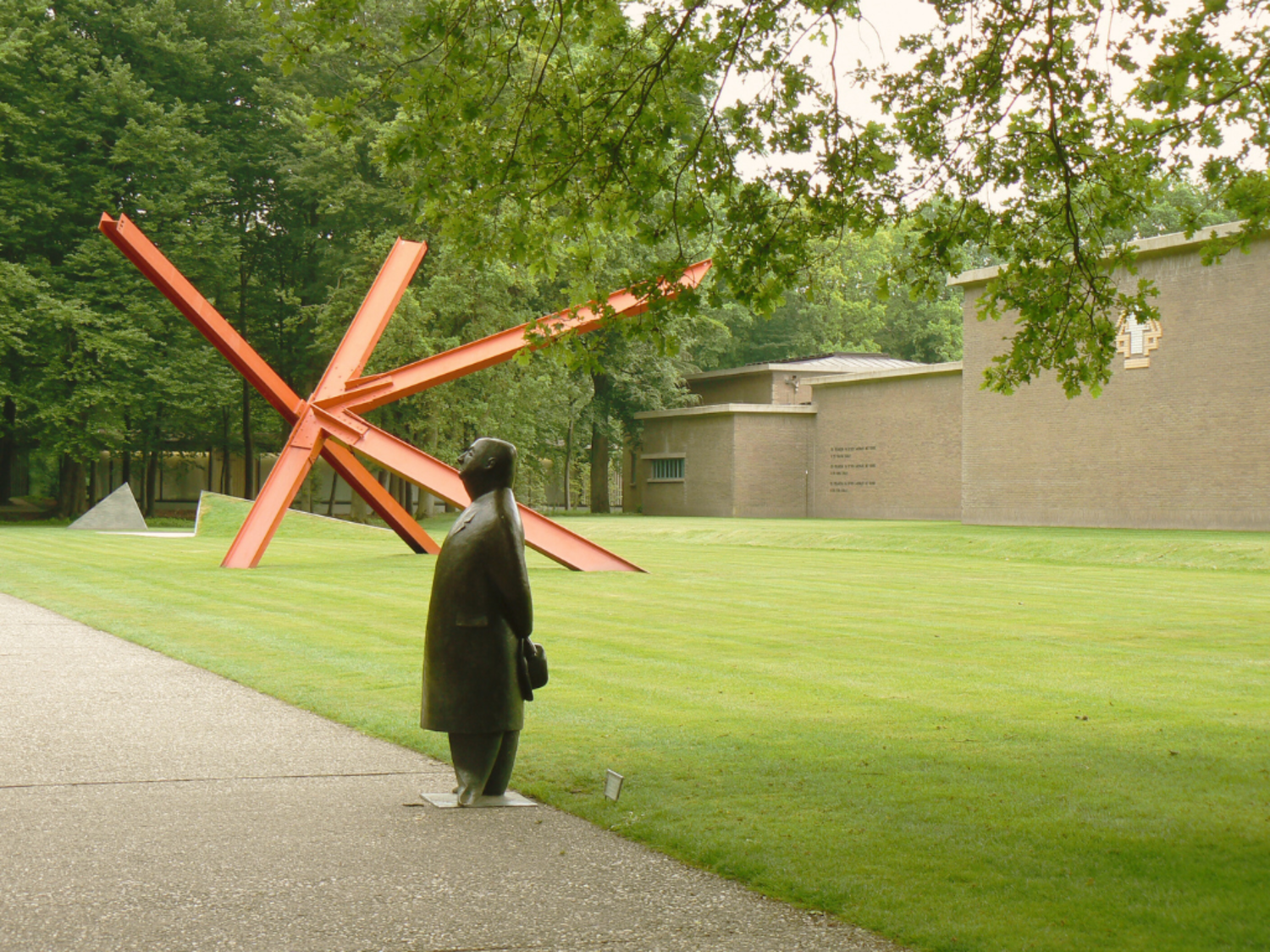
The art might be the reason you go, but the sculpture garden is the reason you stay. It's one of Europe’s largest and most thoughtfully designed, with more than 200 works spread across lawns, forest clearings, and open meadows.Expect a mix of modern and contemporary sculpture integrated so naturally into the landscape that discovery feels organic rather than programmed. Two architectural highlights—the 1960s pavilions by Aldo van Eyck and Gerrit Rietveld—are part of the experience, reinforcing the idea that space itself is a form of art.
Do not try to see everything. Choose a loop and let scale and distance do their work. For families or mixed-age groups, this is often the most joyful part of the visit.
4:30–5:00: A final pass
Before you go, you may want to return briefly to the galleries for one last view before the museum closes. Then, exit through the park, ideally by bike, with that quiet, end-of-day clarity that only art and fresh air together seem to produce.Planning Ahead: The Fall 2026 Van Gogh Exhibition
In fall 2026, the Kröller Müller Museum plans to display all 88 of its Van Gogh paintings together, a rare and ambitious presentation running from mid-September 2026 through early January 2027.
This is the kind of exhibition people plan entire trips around, and preparation matters.
- Book early and aim for a weekday morning if possible. Remember that you’ll need both park and museum tickets, and factor in travel time inside the park itself.
- Whenever you visit, don't assume every famous painting will be present without checking. For example, "Terrace of a Café at Night" is scheduled to return from Japan only around September 2026, so availability may be tight at the beginning of the exhibition window.
- Before you arrive, decide on your Van Gogh focus. You might follow his relationship with people and labor, his evolving approach to nature, or his technical development from heavy, dark paint to brighter, more expressive color. This is where visiting the Kröller-Müller with an art historian is of incredible value.
- Plan a two-speed visit: one slow, focused hour of deep looking, followed by a looser, more intuitive pass. Pairing the exhibition with time outdoors in the sculpture garden helps prevent visual overload and keeps the experience fresh.
Finally, stay flexible. The Kröller-Müller is a living museum, with loans and rotations that reflect its active role in the international art world.
A Few Final Tips
Wear comfortable shoes. This is a museum-plus-landscape day.
Bring layers; the sculpture garden and park are exposed to changing weather.
Use the white bikes if you can. They are part of what makes the visit unique!
And above all, remember the dual-ticket system: park entry and museum entry are both required.
The Kröller-Müller Museum is not just a place to see great art. It’s a place to experience how art lives in the world, how it's shaped by landscape, light, and the pace at which you move through it.
Whether you visit now or plan around the ambitious Van Gogh presentation in fall 2026, the Kröller-Müller Museum offers something increasingly rare: space to think. Space to walk, to look, to connect ideas across time and movement. In a world of fast travel and faster consumption, this museum invites you to slow down and rewards you richly when you do.
Give it a full day, an open mind, and a little effort to get there. What you’ll gain in return is perspective, clarity, and one of the most memorable museum visits in Europe.