Google "things to do in Seoul" and you'll get a palace, a market, a skyline, and about a thousand K-drama filming locations, all thrown together with zero sense of how any of it fits. Which is a shame, because it does fit, if only you have someone to help you put the pieces together.
The same short walk can take you from a 14th-century royal court to a Cold War flashpoint to the exact street corner from "Parasite." That range is part of what makes South Korea so rewarding to explore. It can also make deciding where to begin a challenge.
Context currently offers four private tours in Seoul, each approaching the city from a different angle: an introduction to its defining history, a deep dive into Korean food culture, and two neighborhood tours that explore less familiar chapters of the capital.
The best choice depends less on how much Korean history you already know and more on what you want Seoul to help you understand.
Sites & Insights: Seoul City Tour
Best for: First-time visitors, history lovers, and travelers who want context before exploring independently.
If Seoul is the beginning of a longer trip through South Korea, start here.
The three-hour Sites & Insights: Seoul City Tour uses some of the capital's most recognizable places to establish the larger story of the city. Beginning around Gwanghwamun Square, the tour connects Korea's royal past with its civic and political life before continuing into Gyeongbokgung Palace. The final portion can shift toward Seochon or the area around Cheong Wa Dae depending on your interests.
What to expect
This isn't meant to be a checklist of Seoul's major attractions. Instead, your Expert uses a few carefully chosen places to explain ideas you'll encounter throughout your trip: the Joseon dynasty, colonization, reconstruction, political protest, and the relationship between historic Korea and the country you see today.
It's particularly useful early in a visit because it gives you a framework for everything that comes afterward.
What you might take away: Seoul's history isn't confined to its historic sites.
A palace can look like a window into a distant dynasty, while a public square can seem entirely contemporary. But in reality, that's not entirely true. This tour begins to collapse the distance between sites that at first glance seem unrelated. You may start noticing how questions of power, national identity, preservation, and civic participation continue to connect places built centuries apart.
By the end, Seoul can feel less like a city divided between "old" and "new" and more like one long, continuing conversation.
Seoul Street Food Tour
Best for: Food-motivated travelers, adventurous eaters, families, and anyone intimidated by ordering in Seoul's markets.
Gwangjang Market is exactly the kind of place where having someone knowledgeable beside you changes the experience.
There are steaming counters, tiny stools, unfamiliar ingredients, Korean signs, and enough competing aromas to make choosing your first dish surprisingly difficult. This Seoul Street Food Tour turns that abundance into an introduction to how Koreans actually eat.
Depending on what's fresh and available, tastings might include dishes such as bindaetteok, crisp mung bean pancakes traditionally paired with makgeolli, or mayak gimbap, small seaweed rice rolls. More adventurous guests may encounter dishes they would never have ordered on their own, while your Expert can adjust selections around your preferences and comfort level.
What to expect
Come hungry!
Over three hours, you'll move through Gwangjang Market and its surrounding streets, stopping at food stalls while learning why particular dishes matter, how market culture developed, and how Korean dining customs work.
The experience is less about completing a fixed tasting menu and more about learning how to understand the market: what people are eating, how dishes are ordered, and what certain foods reveal about everyday life in Seoul.
What you might take away: Confidence.
The most valuable part of a food tour may not be discovering your favorite Korean dish; it might be realizing that the market no longer feels incomprehensible afterward. You'll begin to recognize what you're looking at, understand how people order and eat, and have a vocabulary of dishes you can seek out later.
In other words, this is a tour that can make the rest of your trip taste that much better!
Buam-dong Neighborhood Tour
Best for: Return visitors, literature and film lovers, travelers who like neighborhoods more than monuments, and anyone curious about a quieter side of Seoul.
A short journey north of central Seoul changes the city's rhythm dramatically. This Buam-dong Neighborhood Tour heads into a hilly district where mountain landscapes, fortress architecture, literary history, Cold War memory, and contemporary culture overlap.
Stops can include the Cheongun Literature Library, the Hill of Poet Yoon Dong-ju, Changuimun Gate, Mugyewon, and a filming location from Parasite.
This is not the Seoul of enormous intersections and neon-lit shopping streets. It is leafy, steep, residential, and much more intimate.
What to expect
Expect hills, and expect the story to move between periods in a way that feels appropriate to the neighborhood itself.
You might move from the 1968 Blue House Raid and Cold War Seoul to the poetry of Yoon Dong-ju, then encounter the old Seoul City Wall or a place recognizable from contemporary Korean cinema.
The landscape is as important as any single monument.
What you might take away: a different sense of Seoul's geography.
Seoul's global image tends to emphasize density, speed, technology, and scale. Buam-dong complicates that viewpoint.
From the city's northern hills, mountains become part of the story. Fortress walls make clear older boundaries. Literature connects political history to individual experience. Even current-day Korean pop culture begins to sit within the physical city that produced it.
You may leave realizing that understanding Seoul means looking beyond its skyline.
Jeong-dong Neighborhood Tour
Best for: Serious history lovers, travelers interested in politics and cultural exchange, architecture enthusiasts, and anyone wondering how Korea became the country it is today.
Of the four tours, the Jeong-dong Neighborhood Tour may tell the least familiar story.
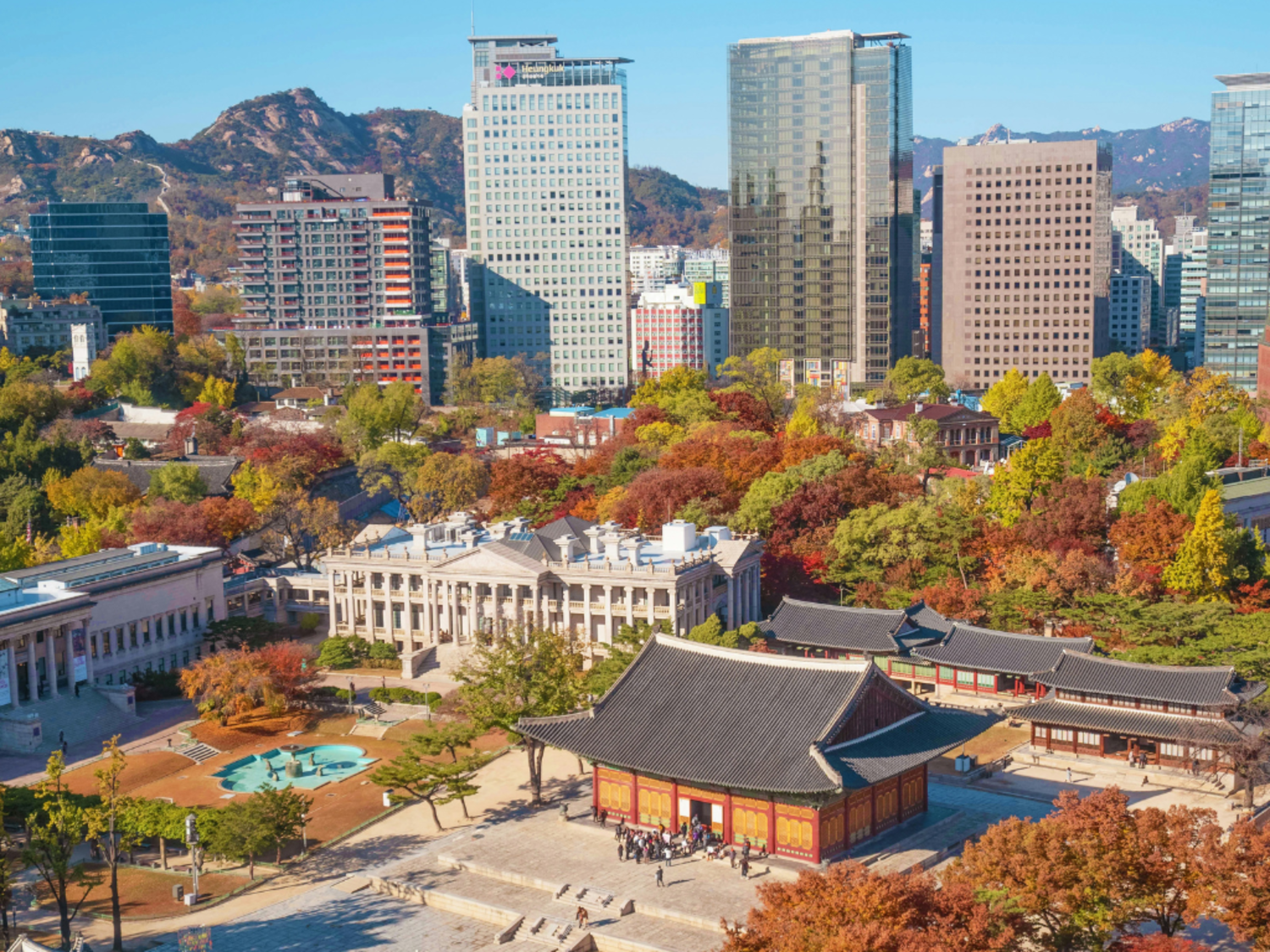
Jeong-dong preserves an extraordinary concentration of places connected to the final decades of the Joseon era, when foreign diplomats, missionaries, educators, reformers, and competing empires were reshaping life in Korea.
The route includes Deoksugung Palace, the Road of Emperor Gojong, remnants of the former Russian Legation, early schools, and one of Seoul's important early Protestant churches.
What to expect
Think of this less as a traditional palace tour and more as a story about a society in transition.
One moment you are examining royal architecture; the next, you're discussing Emperor Gojong's flight to the Russian Legation in 1896. Schools open a conversation about education and women's public lives. Churches and Western-style buildings raise questions about missionaries, foreign influence, and modernization.
The appeal lies in seeing major historical forces at street level.
What you might take away: A more nuanced understanding of how modernization has affected Seoul.
Here, new ideas are juxtaposed with national pressure. Education created opportunities while imperial competition threatened sovereignty. Architecture borrowed new forms while the monarchy fought to survive.
You may come away with fewer simple conclusions, but a far richer understanding of how dramatically Korea changed around the turn of the twentieth century and how many people were negotiating what that change should mean.
So, which Seoul tour should you choose?
- If you're visiting Seoul for the first time, Sites & Insights offers the strongest foundation. It gives the rest of the city historical coordinates and makes an excellent first tour.
- If your curiosity tends to begin at the kitchen table, choose the Seoul Street Food Tour. You'll eat extremely well, but you'll also gain the confidence to explore Korean food independently afterward.
- If you already know Seoul's headline attractions, or simply prefer discovering places that feel slightly removed from the usual visitor circuit, choose Buam-dong. Its combination of literature, political history, landscape, and contemporary culture reveals a side of the capital that's easy to miss.
- If the question that fascinates you is how Korea became modern, choose Jeong-dong. Its relatively compact streets contain an unusually complex story about diplomacy, education, religion, empire, and cultural exchange.
Of course, the four aren't mutually exclusive. Taken together, they reveal something important about traveling in South Korea: there is no single story that explains the country. Choosing the best tour isn't really about deciding which Seoul you want to see.
It's about deciding what version of Seoul you want to begin understanding.