Ready to venture beyond Seoul’s old city walls? Buam-dong is waiting for you, bringing together mountain landscapes, Joseon history, modern Korean literature, show-stopping art, and traces of the Cold War. Here’s why this hillside neighborhood deserves a closer look.
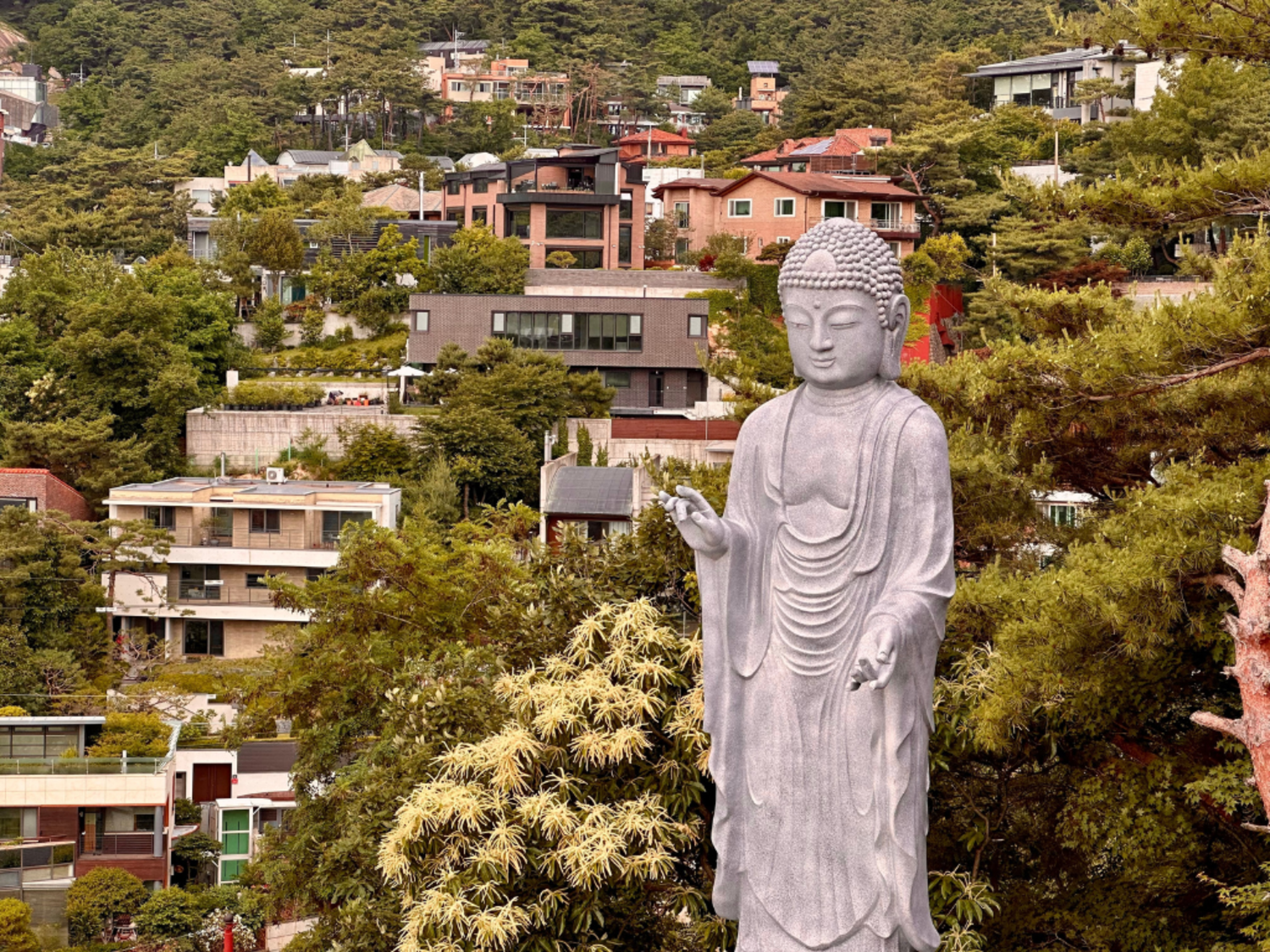
A short journey north from Gyeongbokgung brings you to a very different version of the Korean capital. Major avenues narrow into climbing roads, and low-rise houses follow the contours of the hills. Galleries, cafés, literature museums, and pockets of forest appear between residential streets. Look up, and Inwangsan, Bugaksan, and the larger mountain landscape seem far closer than Seoul’s skyline.
Buam-dong can feel removed from central Seoul, but its history is intimately connected to it. The neighborhood sits beside a centuries-old city gate; in fact, its hills became places of retreat for members of the Joseon court. One of Korea’s most beloved modern poets walked nearby, and in 1968, this area was at the center of one of the most dramatic episodes of Cold War-era Seoul.
It is precisely this combination that makes Buam-dong worth visiting. Rather than presenting a single chapter of Korean history, the neighborhood lets several periods occupy the same space. You're invited to uncover what appeals to you most.
Where Is Buam-dong?
Buam-dong lies in Jongno-gu, north of Gyeongbokgung Palace and around the pass between Inwangsan and Bugaksan. Its position near the mountains has helped preserve a markedly different scale from much of central Seoul. Its steep lanes, streams, wooded paths, traditional architecture, and relatively few tall buildings are what has made the area known for its scenery since the Joseon period.
One of the best ways to understand its geography is through Changuimun Gate, which once marked one of the smaller entrances through the walls of Hanyang, as Seoul was known during the Joseon dynasty. Crossing this threshold historically meant leaving the formal walled capital and entering the landscape beyond it.
A Brief History of Buam-dong
How Buam-dong Got Its Name
“Buam” comes from buchimbawi, or “attaching rock,” a roughly two-meter-high rock that once stood in the area. According to local tradition, people would attempt to make a smaller stone adhere to its surface while making a wish. Over time, the rock became particularly associated with women wishing for a son. It disappeared during road expansion around 1970, but its name survives in Buam-dong: the characters 付岩 refer to the idea of attaching something to a rock.
Beyond the Walls of Joseon Seoul
Buam-dong’s history is inseparable from Changuimun. Built as part of the fortifications established under Taejo, founder of the Joseon dynasty, Changuimun was one of the four smaller gates in the Seoul City Wall. It later became associated with the 1623 coup that placed King Injo on the throne. The surviving gatehouse was reconstructed in the 18th century and is the only gate tower among Seoul’s auxiliary gates to have survived to the present.
But the area outside the walls was not simply defensive territory. Its mountain scenery also attracted people looking for places to retreat, study, paint, and write.
At the site now associated with Mugyewon, Grand Prince Anpyeong (the third son of King Sejong) established a villa called Mugaejeongsa. According to tradition, its landscape reminded him of a paradise he had encountered in a dream. The celebrated court painter An Gyeon subsequently created Dream Journey to the Peach Blossom Land, one of the best-known paintings of the Joseon period.
Buam-dong and the Literature of Yun Dong-ju
The neighborhood's connection between landscape and art becomes particularly apparent in the story of Yun Dong-ju, one of Korea’s most revered modern poets.
Yun studied at Yonhi College, today’s Yonsei University, during the Japanese colonial period and spent time walking the slopes around Inwangsan. His poetry is remembered for its restrained language, introspection, and moral concern with what it meant to live conscientiously under colonial rule. Arrested by Japanese authorities in 1943, Yun died in Fukuoka Prison in February 1945, only months before Korea’s liberation.
Today, the Yun Dong-ju Literature Museum occupies a converted water pumping station near the foot of the mountain. Nearby, Poet’s Hill includes a monument inscribed with his celebrated poem Seosi, often translated as “Prologue” or “Foreword.”
The Cold War in Buam-dong
Buam-dong’s strategic geography became significant again in January 1968.
A group of North Korean commandos infiltrated Seoul in an attempt to attack Cheong Wa Dae, the presidential residence. They reached the area around Changuimun before being confronted. Police officer Choi Gyu-sik was killed during the encounter, and a memorial near the gate commemorates him today. The incident led to much tighter security around the mountains north of the presidential compound; sections of Seoul’s fortress trails remained closed to the public for decades afterward.
It is a jarring historical layer in a neighborhood now associated with cafés, museums, and walking trails. The history held within these hills reminds us that landscapes that appear peaceful in the present can carry memories of political anxiety, conflict, and national division.
Things to Do in Buam-dong
Begin at Changuimun Gate
Changuimun is one of the best places to establish Buam-dong’s relationship with the rest of Seoul.
Rather than treating the gate as an isolated historic structure, look at where it stands. The city wall climbs toward the mountains on either side, while the road below follows a natural passage through the terrain. Note how mountains were not obstacles surrounding the city, but part of its defensive architecture.
From here, you can continue toward sections of the Seoul City Wall or head down into Buam-dong itself.
Visit the Yun Dong-ju Literature Museum and Poet’s Hill
Even travelers unfamiliar with Korean poetry can find the Yun Dong-ju Literature Museum compelling.
The former pumping station has been transformed into a spare architectural space that places Yun’s life and work within the history of colonial Korea. Visitors don't need extensive prior knowledge; this venue offers an entry point into questions of language, conscience, artistic freedom, and national identity.
Continue uphill to Poet’s Hill afterward. The relationship between the museum and the surrounding landscape is important. After all, Yun himself walked in this area while studying and writing.
Stop at Cheongun Literature Library
Nearby, Cheongun Literature Library offers a very different encounter with literature.
Built at the foot of Inwangsan, it was designed in the style of a traditional hanok with handmade roof tiles and spaces intended to harmonize with the mountain setting. It functions as an actual public library today, making it an interesting example of how traditional architectural vocabulary can be incorporated into contemporary civic life.
Explore Korean Modernism at the Whanki Museum
Buam-dong’s artistic story does not end with the Joseon court.
The Whanki Museum is dedicated to Kim Whanki, one of the pioneers of Korean abstract art. His work translated subjects deeply rooted in Korea—mountains, moonlight, clouds, white porcelain, and traditional pattern—into increasingly abstract compositions of color, line, and repeated points. The museum holds nearly 300 of his works.
Buam-dong is a great place to hold his collection, as Kim repeatedly drew inspiration from Korean landscapes. The surrounding mountains make the relationship between place and abstraction easier to appreciate.
Walk Through Baeksasil Valley
Few experiences demonstrate Buam-dong’s unusual relationship with nature as clearly as Baeksasil Valley. The protected valley supports salamanders, frogs, minnows, crayfish, and other wildlife, while archaeological traces connect the area to historic villa culture.
Because it is an ecological conservation area, this is a place to visit lightly and respectfully. Visitors are specifically asked not to enter the water in order to protect sensitive species and their habitat.
See Seokpajeong and the Seoul Museum
At the edge of the neighborhood, Seokpajeong introduces another strand of late-Joseon history.
The historic villa is associated with Heungseon Daewongun, the powerful regent and father of King Gojong. Today, the complex forms part of the Seoul Museum site, bringing historic architecture and landscaped grounds into conversation with modern and contemporary Korean art.
A visit here works particularly well if you want to turn a Buam-dong walk into a longer half-day devoted to art and architecture.
Make Time for the Neighborhood Itself
Not every worthwhile stop in Buam-dong has a plaque beside it.
Part of the appeal is simply following the climbing residential roads between galleries, small restaurants, and cafés. The neighborhood also has a long relationship with Korean screen culture: one of its hillside cafés became well known after appearing in the television drama Coffee Prince, while Context’s own Buam-dong route includes a location connected to Parasite.
These references can be entertaining, but they are more interesting when considered alongside everything else happening here. Korean popular culture did not emerge in a vacuum. In Buam-dong, film and television occupy the same physical landscape as Joseon fortifications, colonial-era literature, modern art, and Cold War history.
How Much Time Should You Spend in Buam-dong?
Allow at least half a day if you want to start to understand the neighborhood rather than simply stop at one or two attractions.
A route connecting Changuimun, the Yun Dong-ju sites, Cheongun Literature Library, and central Buam-dong works well in several hours. Add the Whanki Museum, Mugyewon, Seokpajeong, or Baeksasil Valley and the neighborhood can easily fill most of a day.
Expect hills. Buam-dong is best suited to comfortable walking shoes and a pace that leaves room for climbing roads, museum stops, and the occasional detour.
How to Get to Buam-dong
Buam-dong does not have its own subway station, which contributes to its sense of separation from central Seoul.
One of the easiest approaches is to take Seoul Metro Line 3 to Gyeongbokgung Station and continue by local bus toward Changuimun or Buam-dong. Official visitor information for several neighborhood sites recommends this route.
A taxi from central Seoul is another straightforward option, particularly if you plan to begin farther inside the neighborhood.
Why Visit Buam-dong?
Many first trips to Seoul understandably revolve around its defining landmarks: Gyeongbokgung, Bukchon, major markets, museums, towers, and contemporary shopping districts.
Buam-dong is valuable for a different reason. It complicates the version of Seoul defined by speed, scale, and constant reinvention with its calm, natural, and historic sites.
Spend a few hours in Buam-dong, and you'll find you have an entirely new appreciation for Seoul, and perhaps a new favorite neighborhood as well.