For a few days each September, brass bands appear beneath Baroque façades, historic carousels turn in the squares, and market stalls fill Salzburg's Old Town with the smell of grilled food and freshly baked sweets, while locals arrive in dirndls and lederhosen and beer is poured at long communal tables.
This is Rupertikirtag, or St. Rupert’s Day Fair, one of Salzburg’s most beloved traditional festivals.
Held around the feast day of Salzburg’s patron saint, this event highlights regional food, craftsmanship, folk music, traditional dress, and much more. This year, Rupertikirtag takes place September 23–27 in Domplatz, Residenzplatz, Mozartplatz, Kapitelplatz, and Alter Markt in the heart of Salzburg’s Old Town.
Why Does Salzburg Celebrate St. Rupert’s Day?
To understand Rupertikirtag, it helps to know something about the man whose name it carries.
Saint Rupert was an early Christian bishop who arrived in the area around the end of the seventh century. He established the monastery of St. Peter’s Abbey in 696, helping turn the former Roman settlement of Juvavum into an important religious center. He is consequently closely associated with the beginnings of medieval Salzburg and became the patron saint of both the city and the surrounding region.
On September 24, 774, Bishop Virgil consecrated an early cathedral and Rupert's relics were transferred there from St. Peter’s. Later Salzburg cathedrals were also consecrated on September 24, reinforcing the connection between Rupert’s feast day and the religious heart of the city.
Eventually, what began as a religious feast gradually became something much larger.
People from the surrounding countryside came into Salzburg around Rupert’s Day to settle payments and conduct business. Merchants followed. By the Middle Ages, the occasion had developed into a substantial annual market, or Dult, where visitors could buy goods that were otherwise difficult to obtain.
The fair moved, disappeared, and changed form several times over the centuries. In 1977, it was revived around Salzburg Cathedral as the modern Rupertikirtag, deliberately reconnecting the festival with its historic location and traditional character. The 2026 celebration is officially described as the 49th modern cathedral fair dedicated to St. Rupert.
What Is Rupertikirtag Like Today?
Imagine Salzburg’s monumental Baroque squares temporarily becoming a village fair.
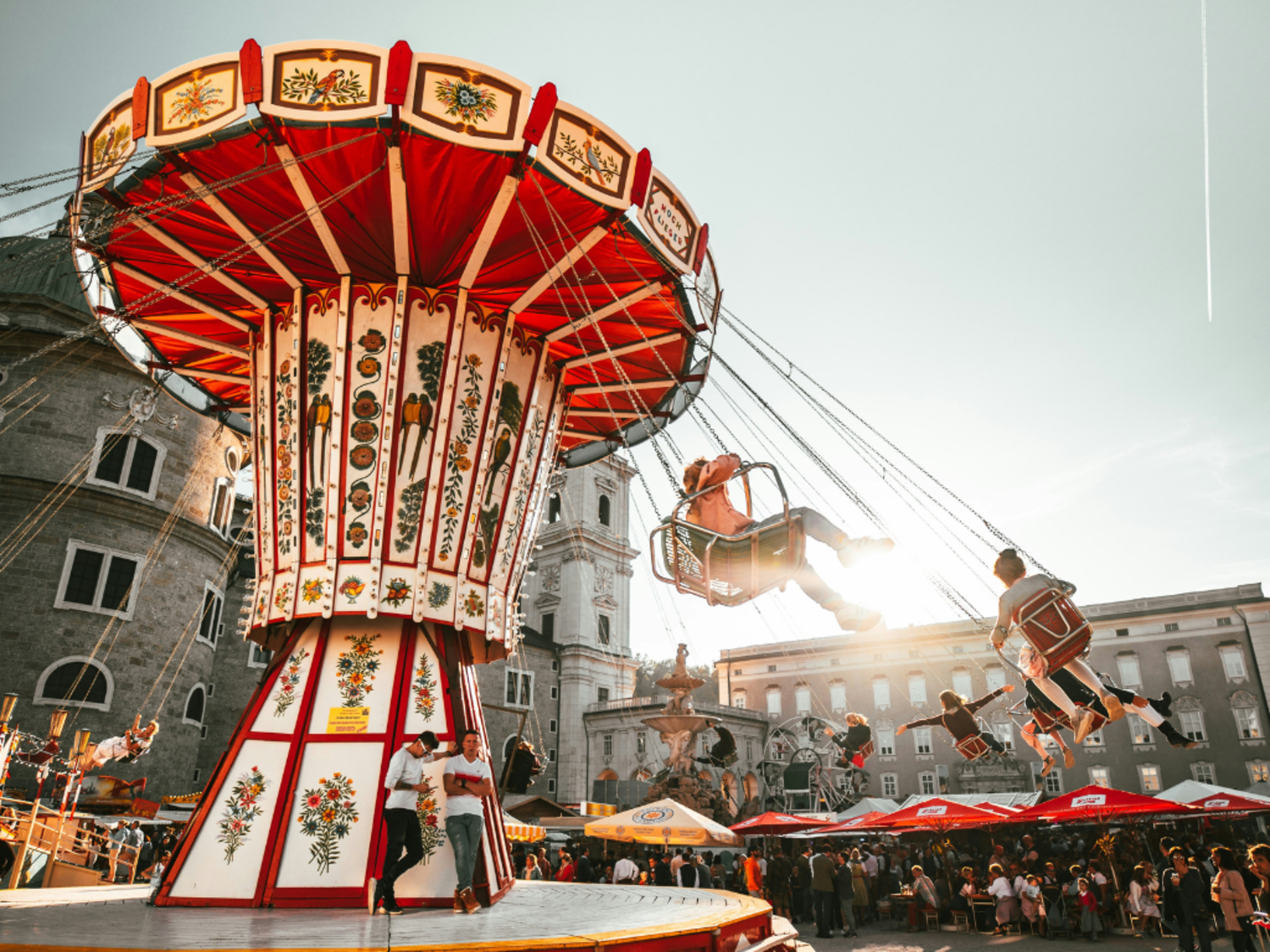
The festival deliberately emphasizes tradition. Historic-style rides, regional food, craftsmanship, folk culture, traditional dress, and live music are central to the experience, giving the fair a nostalgic character. Among its most recognizable sights is the historic chain carousel, alongside traditional merry-go-rounds and other fairground attractions. For families, the rides are a major part of the celebration; for adults, simply wandering between the different squares, stopping for food, music, or a beer, can easily occupy an afternoon.
Rupertikirtag Traditions to Look For
Traditionally, the opening includes a procession toward Cathedral Square, the ringing of the cathedral bells, ceremonial salutes from Salzburg’s civic guard, and the raising of the market flag. A ceremonial tapping of the first beer keg follows in the festival tent. At the end of Rupertikirtag, the flag is lowered again to formally close the celebration.
Presiding over much of this is one of the festival’s more curious characters: Hans Wurst.
A comic figure in German-speaking popular theater, this key character is irreverent, mischievous, and allowed to say things other people can not. Such characters once regularly appeared at fairs and public entertainments.
Salzburg revived its own Hans Wurst tradition alongside Rupertikirtag in 1977. Today, the brightly dressed figure roams the fair, participates in ceremonies, entertains visitors, and raises and lowers the market flag. His presence is a reminder that European fairs historically mixed commerce and religion with comedy, spectacle, and a certain amount of sanctioned disorder.
What Food Should You Try at Rupertikirtag?
Food at Rupertikirtag tends toward the hearty, convivial side of Austrian cooking rather than Salzburg’s more refined café culture. Traditional festival fare has included roast chicken, roast meats, dumplings, grilled fish, game dishes, sausages, pastries, and regional snacks, although individual vendors and menus vary from year to year.
You are also likely to encounter the sweets associated with Central European fairs, from pastries and confectionery to decorated gingerbread.
And What About the Beer?
Beer is very much part of Rupertikirtag. The main festival tent combines food, communal tables, and live brass music, while other food and drink areas are scattered across the Old Town. The ceremonial tapping of the first beer barrel is itself part of the opening festivities.
For travelers expecting something on the scale of Munich’s Oktoberfest, however, it is useful to adjust the comparison. Rupertikirtag certainly involves beer and Tracht, but its identity is much more closely entwined with Salzburg itself: its cathedral, patron saint, historic market culture, regional crafts, and Old Town. The beer is part of the festival, but certainly not the sole reason for it.
Should You Wear a Dirndl or Lederhosen?
Traditional Austrian dress, or Tracht, is an important part of Rupertikirtag. Many Salzburgers attend in dirndls, lederhosen, traditional jackets, waistcoats, and regional accessories, particularly during major ceremonies and weekend festivities. Salzburg’s tourism authority even describes dirndl and lederhosen as ideal attire for the event.
Traditional clothing has remained part of the region’s cultural vocabulary and has continually evolved, from rural working clothes into festive garments and contemporary fashion. Seeing it at Rupertikirtag therefore offers an interesting glimpse at the way Salzburg celebrates tradition. That being said, wearing Tracht is not required to partake in the fun.
What Music Will You Hear?
Expect folk music and brass bands. Traditional ensembles and cultural groups perform throughout Rupertikirtag, while the main festival tent is particularly associated with brass music. Folk dancing and other displays of regional culture have also long been part of the program.
No matter where you are, expect music to spill into the wider social life of the fair. For visitors, this can reveal a different musical Salzburg from the one encountered in concert halls.
Don’t Miss the Traditional Crafts
One of the quieter pleasures of Rupertikirtag is its emphasis on craftsmanship.
The craft market at Alter Markt traditionally brings together makers and demonstrations of regional or increasingly rare trades. Previous iterations of the fair have highlighted crafts ranging from papermaking and hat-making to traditional leather and decorative work.
Historically, annual fairs were places where Salzburgers encountered objects, skills, fashions, and goods unavailable in everyday life. The contemporary craft market preserves a small part of that original purpose.
What to Expect When Visiting Rupertikirtag
The festival spreads across five connected squares in Salzburg’s historic center: Domplatz, Kapitelplatz, Residenzplatz, Mozartplatz, and Alter Markt. There is no single entrance or prescribed route. You simply begin encountering the festival as you move through the Old Town.
During the day, the atmosphere tends to work particularly well for families and travelers interested in crafts, food, and the historic rides. As the afternoon moves into evening, the beer tents and music become more prominent.
For 2026, Rupertikirtag runs from Wednesday, September 23 through Sunday, September 27. Rides are currently scheduled to operate until 10 p.m., the crafts market at Alter Markt until 6 p.m., and food and music until 10 p.m., with the festival closing at 10:30 p.m. Detailed programming for 2026 is still being released, so individual performances and activities may change.
Because the festival takes place directly in the Old Town, you can easily combine it with Salzburg Cathedral, St. Peter’s Abbey, the Residenz, or a wider exploration of Salzburg’s historic center.
Why Rupertikirtag Is Worth Experiencing
Salzburg can sometimes appear almost impeccably composed with its baroque domes, Mozart portraits, and manicured squares.
Rupertikirtag loosens that image.
For a few days, those same squares become fill with music, ceraft, and revelry. A medieval religious feast sits beside a beer tent. Traditional clothes coexist with everyday dress. Craftspeople work a few streets from luxury boutiques. Children circle the cathedral on an old-fashioned carousel while brass music drifts across the Residenzplatz.
The fair is not simply a celebration held in Salzburg. Its history tells part of the story of how Salzburg itself developed around churches and markets, countryside and city.
And for the curious traveler, that makes Rupertikirtag something more valuable than a seasonal festival. It's a chance to see Salzburg not only as a beautiful historic city, but as a place whose traditions are still very much in use.