Marrakech might be the more popular destination, but Fes has something that's arguably harder to forget. Make your way to this medieval city overflowing with history. The tanners still use the same pits. The madrasas still teach. The bread still comes out of the same neighborhood ovens it has for generations.
Founded in 789 by Moulay Idriss I, Fes became Morocco's first imperial capital and one of the great intellectual centers of the Islamic world. The University of Al Quaraouiyine, founded in 859, is generally recognized as the oldest continuously operating university in the world (it predates Oxford by more than 300 years). Fes el-Bali, the ancient medina, is the largest car-free urban area on earth and contains roughly 9,000 streets and alleys, most of them unmarked.
Getting oriented takes time, and getting it right is best done with the proper company. Here's where to spend your time:
With a Context Expert
1. Walk the medina with a historian
Context's Fes City Tour is a three-hour private introduction that makes the medina understandable rather than merely labyrinthine. Your Expert—a cultural historian who knows this city well—moves through the Al Quaraouiyine mosque complex, the Bou Inania Madrasa, the Chouara tannery, and the artisan quarters while answering the questions that help make the rest of your visit make sense.
Who built the madrasa, and why? What do the geometric patterns in the tilework encode? Why is the tannery organized the way it is? The tour won't cover everything—after all, nothing can cover everything in Fes—but it gives you the framework to understand what you're looking at for the days that follow.
2. Cook a Moroccan meal from the market up
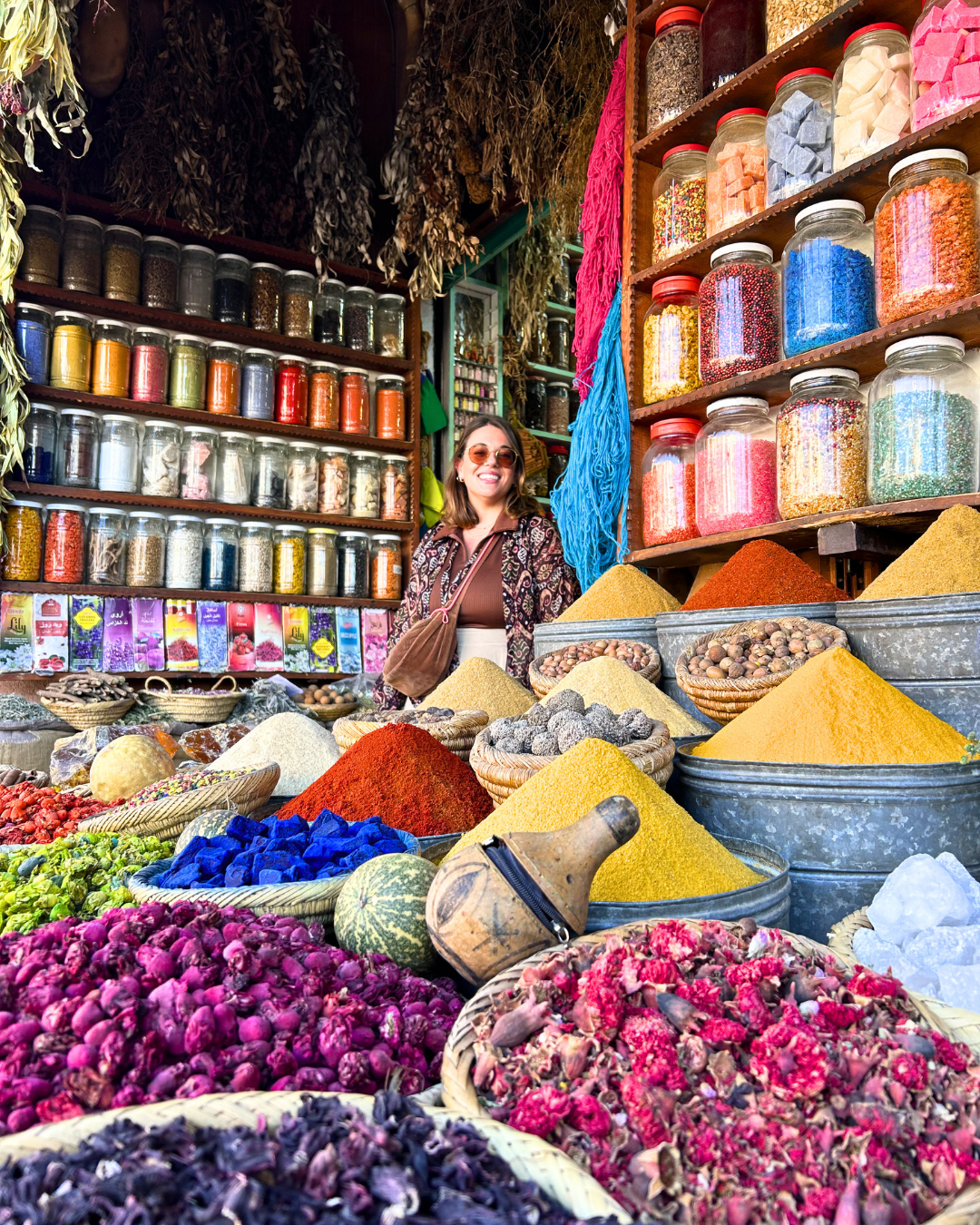
Fes cooking is distinct from Marrakech's; it's richer, more Arab-Andalusian in its spicing, with a depth that reflects the city's centuries as a center of scholarship and refined culture. The Fes Cooking Class: Market and Tagine experience begins in the medina market, where your Expert navigates the spice stalls with a local eye. The session that follows is practical instruction grounded in cultural explanation: where this spice comes from, why a certain technique developed, and what a dish means in the calendar of a Moroccan household.
Three hours + one meal = a significantly better understanding of why Moroccan cuisine is a document of history as much as a set of recipes.
A practical note: eat a small breakfast before the market session and nothing else. The meals produced in these classes are substantial, and arriving genuinely hungry is both more honest and more enjoyable.
3. Make something in the pottery workshop
Fes pottery, noticeable by its bold geometric patterns in cobalt blue and white, is among the most distinctive craft traditions in Morocco. The Pottery Workshop is a three-hour session in a working atelier, led by artisans who can explain both the making and the meaning. The geometric patterning comes from mathematical principles developed within Islamic art as an alternative to figurative representation. Working with it by hand, even clumsily, is a way to understand it that much more.
4. Take a full day to Meknes and Volubilis
This is one of the best day trips available from any Moroccan city, and yet most travelers skip it! Volubilis is a remarkably intact Roman city. In fact, it's home to the second-largest collection of Roman mosaics outside Italy. Volubilis is set in an agricultural plain at the foot of the Zerhoun hills.
Meknes is the least visited of Morocco's four imperial cities, which makes it one of the most satisfying. Don't miss the Bab Mansour gate, one of the finest examples of Moroccan monumental architecture. Context's Meknes and Volubilis Day Trip from Fes connects both sites to the broader arc of Moroccan imperial history. Learn about the Romans who were here before Islam arrived, the Alaoui sultan Moulay Ismail who tried to build a Versailles of his own in the 17th century, and the long thread between them.
Beyond Context
5. See the Chouara Tannery from above
A word of honest preparation: the smell arrives before the tannery does.
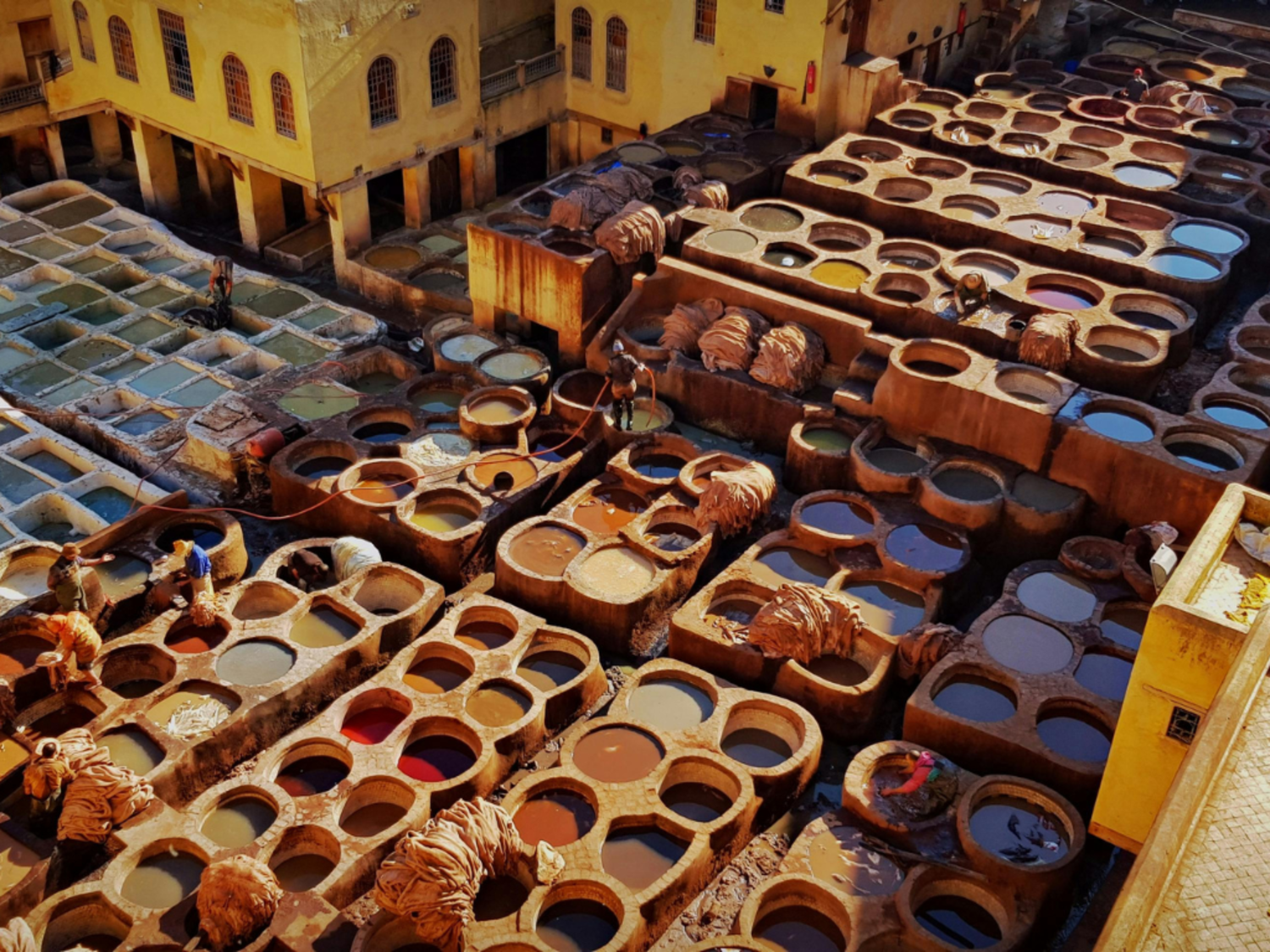
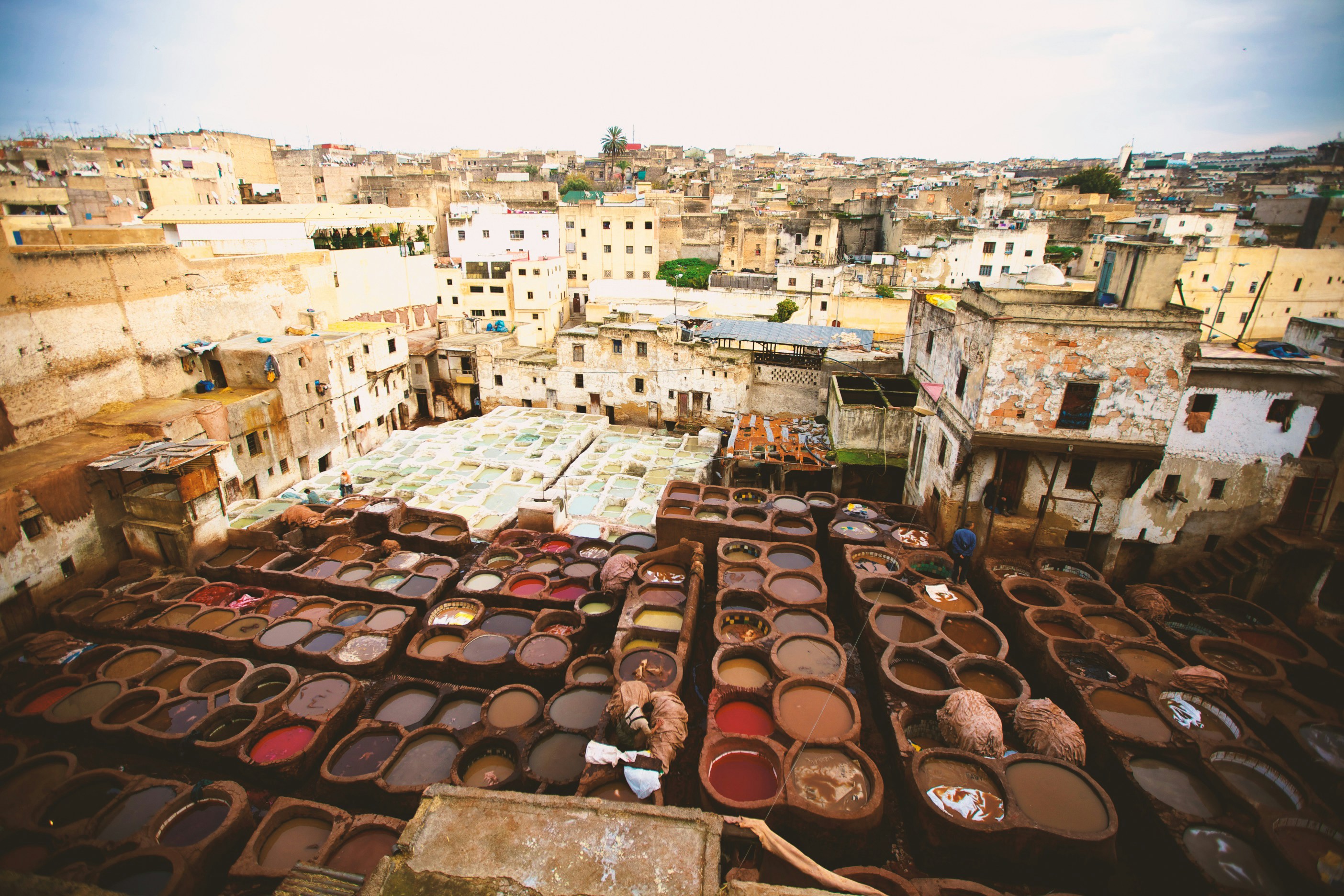
Pigeon dung is one of the primary ingredients in the softening process, and on a warm day it announces itself without subtlety. The leather shops surrounding the tannery all offer rooftop access, and they hand out sprigs of fresh mint when you arrive. Take them. They're not entirely decorative.
The view, however, makes it worth it. The circular stone pits are filled with natural dyes—saffron yellow, poppy red, indigo, the distinctive Fes blue, and more. Workers move hides through stages of treatment, and the whole operation is spread out below you like something from a different century.
And that's because it largely is! The recipe in those pits (a combination of pigeon dung, quicklime, and saffron) hasn't meaningfully changed since the Almoravid period. The guild structure governing who handles the raw hides, who does the dyeing, and who manages the finishing predates most European equivalents. The reason Fes leather became so prized across the Mediterranean world has as much to do with the city's trade networks as its technique. You don't need to buy anything, but go up and breathe through the mint. Take your time learning to dissect the many roles within the tannery.
6. Spend time in the Bou Inania Madrasa
Built in the 14th century by the Marinid sultan Abu Inan, this is the finest example of Moroccan religious architecture in Fes. The triple-layered interior is made up of zellige tilework, carved plaster, and cedar panels. It follows a deliberate progression from the material to the spiritual and once contained a water clock that chimed the hours for prayer. With 13 windows and 13 weights, it was one of the most complex mechanisms of the medieval Islamic world. It's non-functional now, but still there.
A tip on timing: The madrasa is one of the few major monuments in Fes that gets good light in the morning. The interior courtyard faces east, and the tile work reads best before noon. Afternoon visits aren't wasted, but morning is better.
7. Visit the Al Quaraouiyine library
Non-Muslims cannot enter the mosque itself, but the library, which was opened to the public in 2016 after a careful restoration led by Moroccan architect Aziza Chaouni, is accessible and significant. It holds manuscripts dating back to the 9th century. Standing in the world's oldest continuously operating university where professors are still teaching changes how Fes feels.
8. Walk through the mellah
Fes's historic Jewish quarter (adjacent to the royal palace) tells a story of coexistence and eventual departure. Morocco's Jewish community was one of the most significant in North Africa for centuries, and its imprint on Fes's commercial and intellectual life is legible in the architecture, the synagogues, and the cemeteries. The Ibn Danan Synagogue has been restored and repays a visit. Most travelers walk past the mellah without stopping.
9. Go to the Potters' Quarter at Ain Khail
Outside the medina walls, the ceramics district is where Fes's famous blue-and-white pottery is produced on a working scale. The kilns, the production line from raw clay to finished glaze, the cooperative structure of the craft... They're all visible and largely unvisited by tourists who buy the finished products without knowing where they came from.
10. Eat dinner in a riad courtyard, not on the tourist drag
The streets around Bab Bou Jeloud are lined with restaurants aimed at visitors. They are not where you should eat. The Rcif neighborhood has several riad restaurants that serve more genuinely Moroccan food. Riad Fes and the Palais Amani both have serious kitchens. You'll commonly find a set menu in a courtyard, with usually five or six courses beginning with salads and ending with pastilla au lait. This is one of the better dining experiences Morocco offers.
11. Buy something directly from a cooperative
Leather goods, ceramics, handwoven textiles, hammered copper: Fes produces all of them at high quality. The difference between buying well and buying badly is buying directly from a cooperative rather than a tourist shop. Pay in dirhams rather than euros. The price is better and the money goes further in the right direction.
A helpful tip on bargaining: The first price quoted in the souk is rarely the real one, but the gap between opening price and fair price is often smaller than traveler lore suggests. Aim for 60–70% of the opening ask, accept that you'll probably still pay more than a local, and move on. Aggressive bargaining past a certain point becomes uncomfortable for everyone.
12. Sit in a hammam
Fes has several historic neighborhood hammams still operating as they have for centuries. Les Bains Andalous near the Al Quaraouiyine is one of the more accessible for visitors. An hour here is a more revealing window into daily Moroccan life than most of the monuments.
13. Take a morning walk before the city wakes up
The medina between 6 and 8 a.m. is a different city from the one that receives visitors. The bread ovens are working, the mule carts are running, the call to prayer still echoes through streets that don't yet have tourists in them. Get lost deliberately. This is what the place actually is.
A few tips on navigation and mules: Google Maps frequently fails inside Fes el-Bali. The streets are too narrow and too densely packed for satellite positioning to keep up. Locals will offer to help you find your way; some are genuinely helpful, some will expect payment or steer you toward a shop. Accept help graciously, agree on nothing financial upfront, and accept that getting lost is not a failure.
As you walk through the city in the morning light, know that while Fes el-Bali has no cars, it does have mules and donkeys carrying goods through the same narrow streets you're walking. They have right of way. Press yourself against the wall, let them pass, and don't stand in a doorway—some open outward without warning.
Wondering what shoes to wear? The medina's paving stones are uneven, sometimes wet, and frequently carry a light film from dye runoff near the tannery or wood shavings near the carpenters' quarter. Wear shoes you don't mind getting dirty.
14. Give the city more time than you planned
Most itineraries allocate two nights to Fes. Most travelers who follow this advice wish they'd stayed longer. The medina doesn't give itself up quickly. The third day is usually the best one, as that's when you've stopped navigating and started noticing.
Best time to visit Fes
Spring (March to May) and autumn (September to November) are the most comfortable months. Summer in Fes is hot, even hotter than Marrakech because Fes sits further inland. Adjust your hours accordingly and aim to explore in the early morning and late afternoon. You won't want to be anywhere near a souk at 2 p.m. in July.
Winter is mild, quiet, and underrated. Ramadan transforms the city; it's calmer by day, extraordinary after iftar.