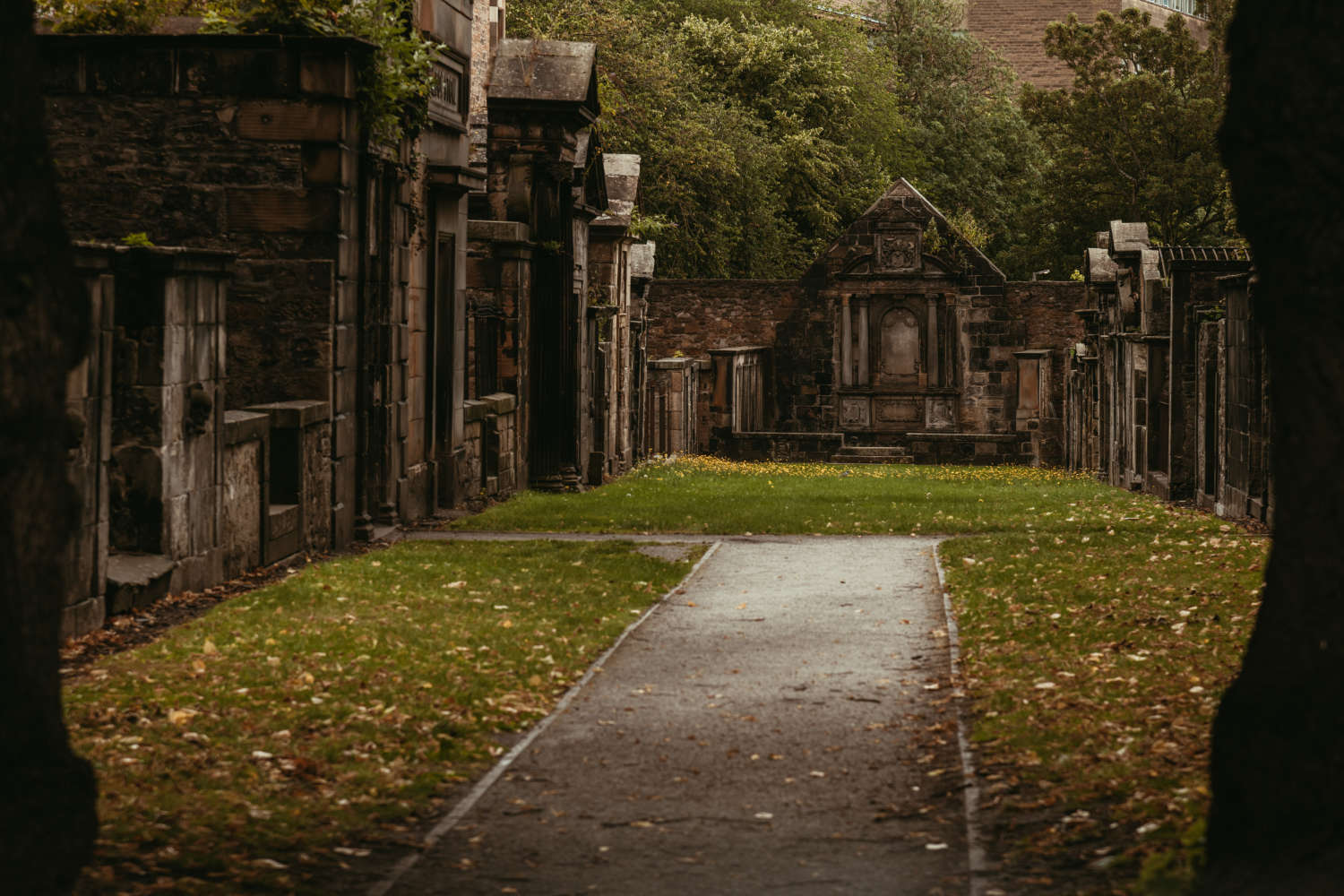
Walk into Greyfriars Kirkyard from Candlemaker Row and you step up, not down.
The ground inside the walls is higher than the street outside. In some places, by several feet. That isn't the product of landscaping, but rather four and a half centuries of burials in a space of a few acres, in a city that for most of its history had nowhere else to put its dead. Nobody knows the exact total, but estimates run into the tens of thousands.
That's the first thing to understand about Greyfriars, and it explains more than the ghost stories do. This is a small piece of ground at the southern edge of Edinburgh's Old Town where an enormous amount of history happened, most of it within sight of the rest of it. A document was signed here that helped bring down a king. Twelve hundred prisoners were held in a corn of it, in the open air, through a Scottish winter. Body snatchers worked it for the medical schools. And the man responsible for those prisoners is buried about a hundred feet from where they died.
Greyfriars gets called the most haunted graveyard in the world. The more interesting claim is that it may be the most densely historical. The two are related.
A note on the word: a kirk is a church in Scots, so a kirkyard is a churchyard. Greyfriars is both — a working church and the burial ground around it.
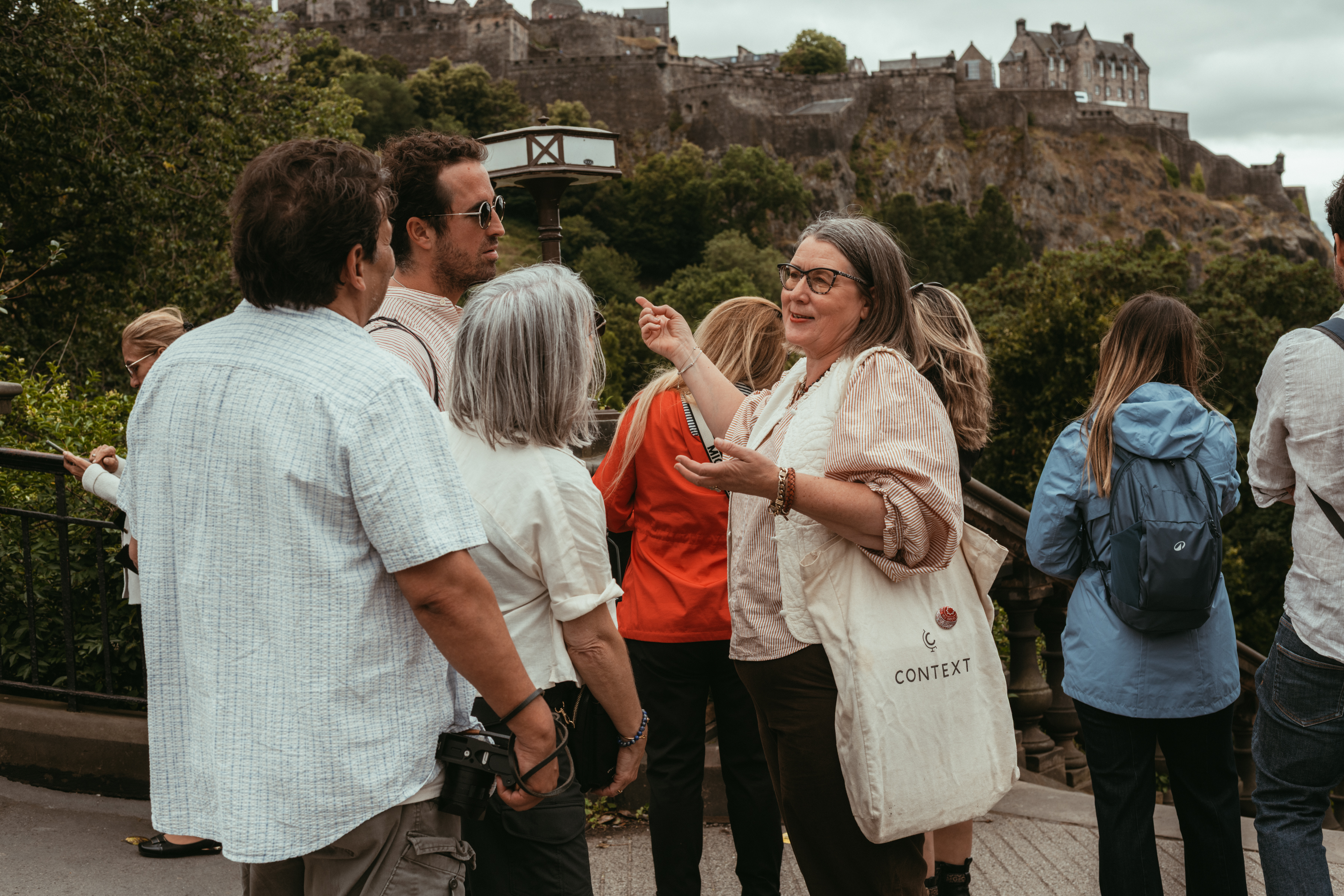
To separate the documented history from the folklore, we asked Jenny Litster, an Edinburgh historian who leads Context Travel's Edinburgh Darkside Tour, to walk us through what this ground actually holds.
Read on to discover what happened here, if you dare...
Why the graveyard exists: 1561
Greyfriars is named for the Franciscan friars who had a monastery on this site until the Reformation. They wore gray habits. The house was shut down in 1560, when Scotland converted from Catholicism to a stricter form of Protestantism, in the same upheaval that stripped the altars out of St Giles' Cathedral up the hill and rewrote the country's whole relationship with the dead.
Edinburgh's city council voted to create a new burial ground in April 1561. It was formally established in August 1562, with royal approval from Mary, Queen of Scots, in the year after she returned to Scotland to take the throne.
The reason was mundane. The churchyard at St Giles' on the Royal Mile was full. Edinburgh in the sixteenth century was a walled city built on a ridge, packed vertically because it couldn't expand outward, with the death rate you'd expect from those conditions. Greyfriars was overflow capacity. St Giles' stopped taking burials around 1600.
So Greyfriars wasn't built as a monument to anything. It was built purely because people were dying faster than the city could bury them, and the evidence of that is still under your feet the moment you walk in.
Jenny has a line she uses to make this land.
"Greyfriars is at Edinburgh’s heart (the 'dead centre', as the old joke goes) with beds of fragrant medicinal plants circling the weathered headstones. I like to direct the visitor’s gaze to the green grassy spaces and say these simple words: '750 grave markers, 100,000 bodies.' There’s usually an immediate look to the feet, a sudden realisation of what lies beneath. Edinburgh’s story is one built in layers through time, and some of these layers are six feet under."
— Jenny Litster, Context Expert, Edinburgh
The church at the center of the ground, Greyfriars Kirk, went up between 1602 and 1620. It was the first new church built in Edinburgh after the Reformation.
The document that started a war: 1638
On February 28,1638, inside Greyfriars Kirk, Scots began signing the National Covenant.
King Charles I was trying to impose a new prayer book on the Scottish church, along with a structure run by bishops he appointed. To Scottish Presbyterians, this was the crown reaching into matters of conscience where it had no business. The Covenant was their answer: a pledge to defend their own church settlement, and a declaration that they recognized only God as its head. Which was, read plainly, a denial that the King had authority over their faith.
Thousands signed, first in Edinburgh and then across Scotland.
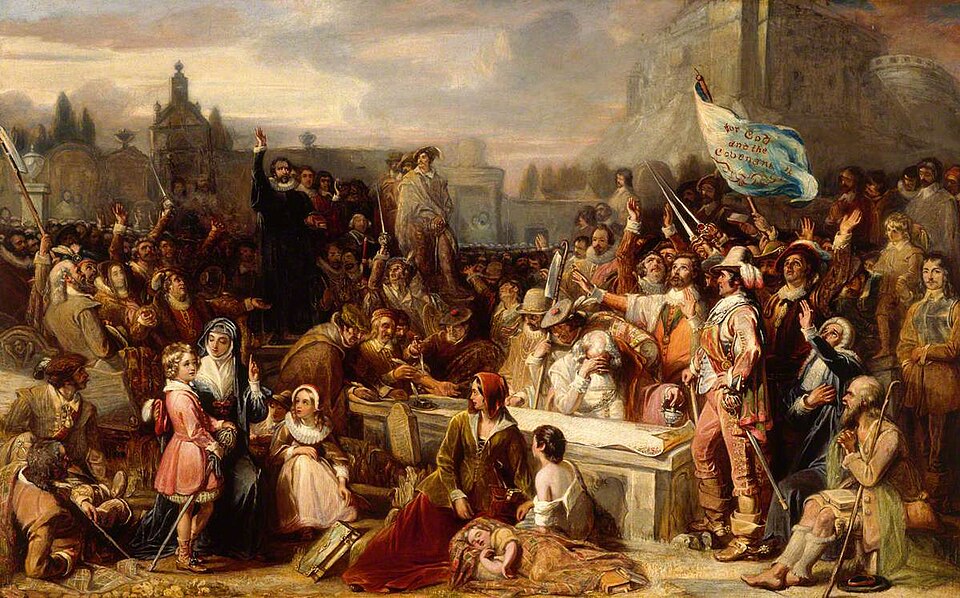
(The Signing of the National Covenant in Greyfriars Kirkyard, Edinburgh)
The consequences were enormous. The Covenant triggered the Bishops' Wars between Scotland and England, which helped set off the broader civil wars of the 1640s, which ended with Charles I on a scaffold. A petition signed in an Edinburgh churchyard is part of the chain of events that led to a king losing his head.
The Covenanters' Prison: 1679
In June 1679, government troops crushed a Covenanter army at the Battle of Bothwell Brig. Around twelve hundred prisoners were marched to Edinburgh and penned in a field at the southern edge of Greyfriars Kirkyard.
They were the sons and grandsons of the men who had signed the Covenant in the church a few dozen yards away. They were imprisoned for holding to it.
The conditions were severe by design. The enclosure was fortified but had no roof. The prisoners had almost no shelter, inadequate food, and no protection from the weather. They were held there for months. Many died of exposure, starvation, and disease. Others were executed, or shipped off to the colonies, or eventually released after signing loyalty bonds.
That corner of the kirkyard is still there, walled off behind a locked iron gate. You'll sometimes see it described as an early prototype of the concentration camp, which is arguable in either direction. What isn't arguable is that a large number of people died of deliberate neglect in a space you can see from the main path.
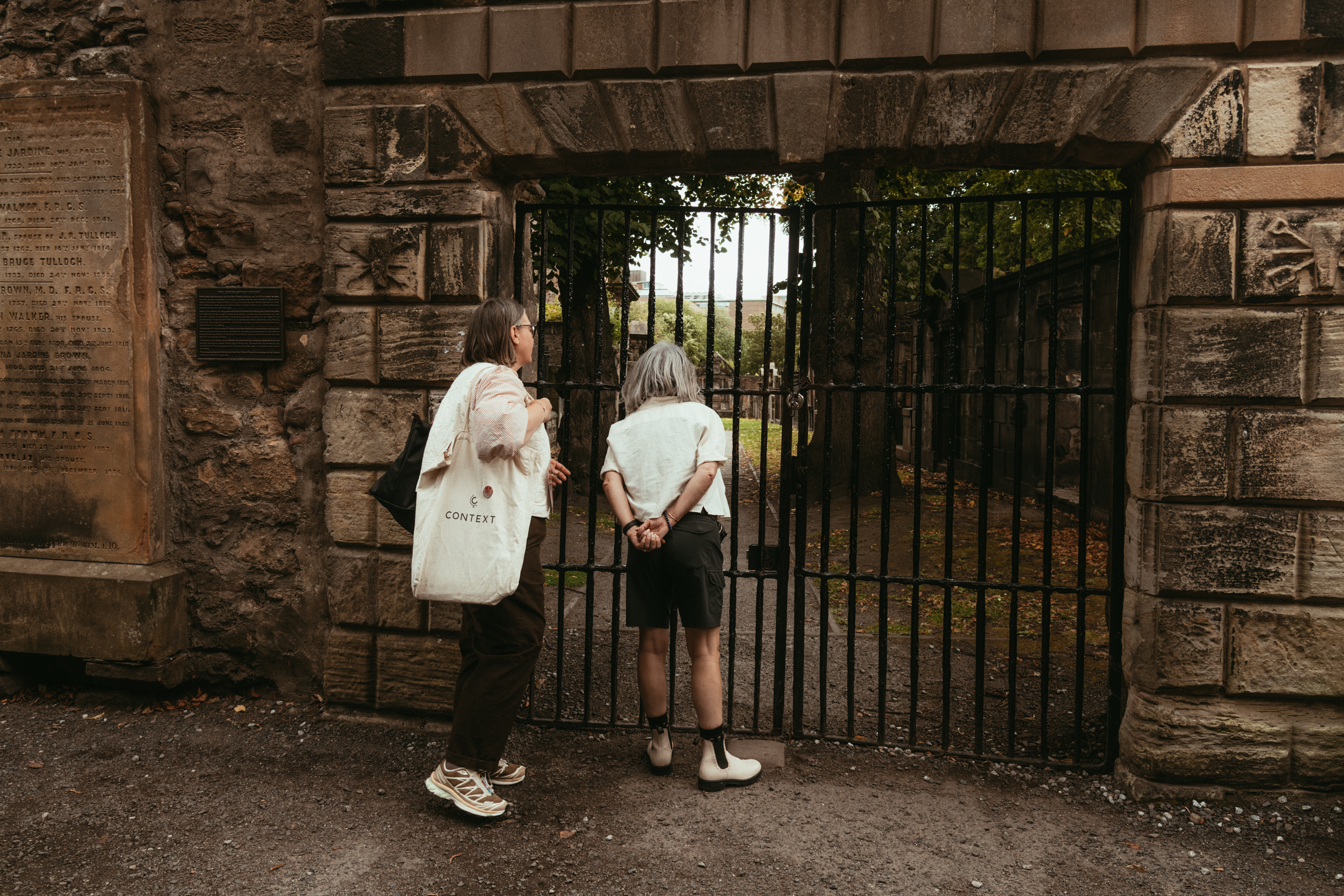
The man who ran that policy was Sir George Mackenzie of Rosehaugh, Lord Advocate for Scotland — essentially the country's chief prosecutor, roughly the equivalent of an attorney general.
Bluidy "Bloody" Mackenzie and the Black Mausoleum
Mackenzie was a serious figure, and worth understanding as more than a villain. He was a lawyer, an essayist, a legal theorist, and the founder of what became the National Library of Scotland. He also personally drove the prosecution of the Covenanters through the years Scots still call the Killing Time. That's what he's remembered for, and it earned him a nickname that outlasted his scholarship: Bloody Mackenzie.
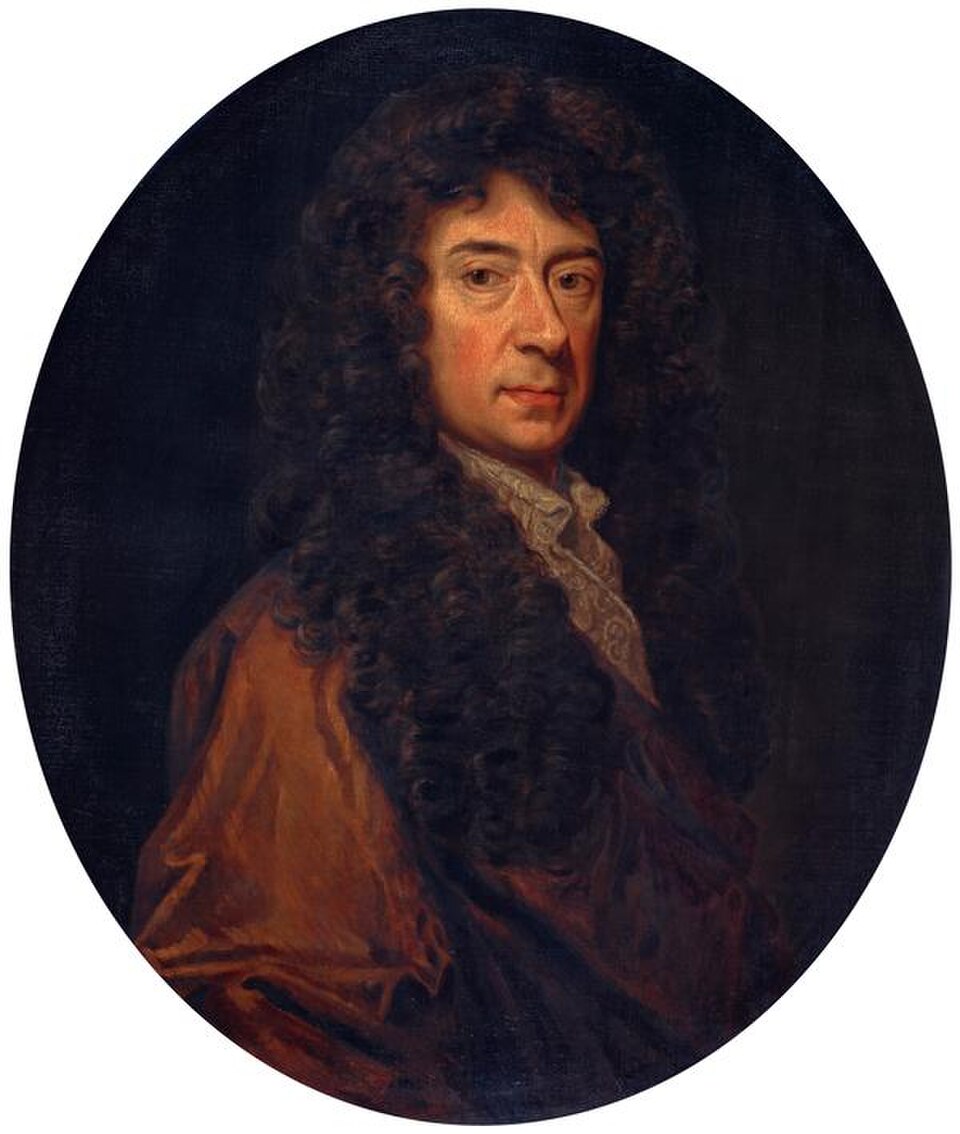
He died in 1691 and was buried in a domed, columned mausoleum, the grandest structure in the kirkyard. It sits near the boundary wall, about a hundred feet from the ground where the Bothwell Brig prisoners were held. Historians disagree about whether he chose that spot out of pride in what he'd done or for ordinary reasons of family land and status. Both readings have been used to explain what came later.
The haunting is older than the story you've probably heard. The modern version starts in December 1998, when a homeless man looking for shelter from a storm broke into the mausoleum, fell through the floor into an older burial pit underneath, and ran. What followed was a wave of reports from the adjoining Covenanters' Prison: scratches, bruises, cold spots, people collapsing. The accounts run into the hundreds. Edinburgh's city council locked the section, and it's now accessible only on licensed tours. Two attempted exorcisms are on record. The story has generated books, documentaries, and a whole tourism industry.
But a Victorian history of the city, Cassell's Old and New Edinburgh, records that nineteenth-century children already believed Mackenzie couldn't rest in his grave. Boys from George Heriot's School next door would run to the mausoleum at lunchtime, bang on the door, and shout a rhyme daring him to come out. The tomb had a reputation more than a century before 1998.
So what happened in 1998 wasn't the start of the haunting. It was the moment a local tradition went global.
We asked Jenny whether she or anyone she knows has experienced anything in Edinburgh they couldn't explain.
"The flippant answer would be 'the price of a croissant'.
There’s many an Edinburgh tour guide with a tale to tell, who has learned to hover outside the tomb, letting visitors explore 'at their own peril'. I’m not one of them. Things have never gone bump in my night. Which is not to say that you’ll find me in Greyfriars at midnight on Hallowe’en, or Samhain, when the veil between the living and the dead is at its thinnest."
— Jenny Litster, Context Expert, Edinburgh
The body snatchers
Between roughly 1740 and 1832, Edinburgh had the best medical schools in Europe and a legal supply of cadavers nowhere near large enough to serve them. The gap was filled by body snatchers, and Greyfriars — central, accessible, and very full — was worked hard.
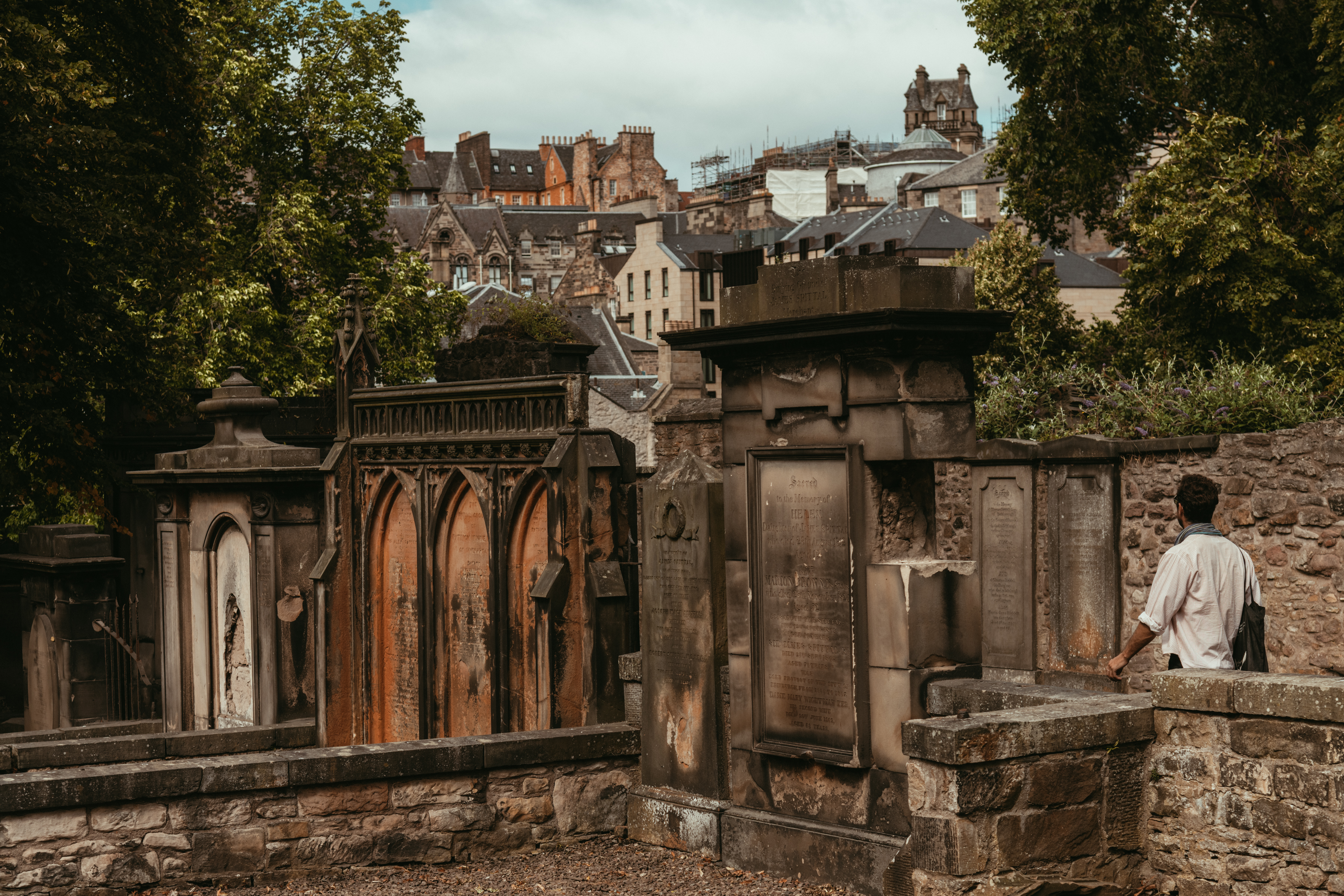
You can still see the response. The kirkyard contains mortsafes: iron cages and heavy stone slabs that families installed over graves to stop them being robbed. The watch house at the entrance was used by relatives keeping vigil over fresh burials until the body was too decayed to be worth stealing.
These are some of the most affecting objects in the kirkyard, and they tell a story about class as much as crime. Iron cost money. Families who had it could protect their dead. Families who didn't, couldn't.
This history gets far less attention than the poltergeist, even though it has documented victims and a clear paper trail. It's also where a lot of visitors end up, according to Jenny— including the ones who booked expecting a ghost.
"The famous Mackenzie Poltergeist is at his mischievous best near the Black Mausoleum, in an area of the burial ground kept under lock and key. Instead I show visitors an iron 'mort safe' – it keeps the dead safe – which unlocks tales of the Resurrection Men – otherwise known as grave robbers. Like all the best Edinburgh stories it has two sides – an illicit trade in fresh corpses, sold to the city’s medical pioneers – the doctors and the devils. From there we can learn about those infamous body snatchers, William Burke and William Hare, who murdered at least sixteen people in 1828 and sold the corpses to a rogue anatomist, Dr Robert Knox.
Up the close an’ doon the stair, but and ben wi’ Burke and Hare.
Burke’s the butcher, Hare’s the thief. Knox is the boy who buys the beef.
Delicious!"
— Jenny Litster, Context Expert, Edinburgh
Who's buried at Greyfriars?
The kirkyard holds an unusual concentration of the people who made Edinburgh one of the intellectual capitals of the eighteenth-century world:
- Allan Ramsay: poet, central to the revival of writing in Scots
- James Craig: the architect who designed Edinburgh's New Town, one of the most complete Georgian city plans anywhere
- James Beattie: philosopher, and one of David Hume's sharpest critics
- William Adam: architect, and father of Robert Adam, whose neoclassical style shaped a great deal of early American public architecture
- William Smellie: printer and first editor of the Encyclopaedia Britannica
- George Buchanan: humanist scholar and tutor to King James VI, who later became James I of England and commissioned the King James Bible
There are around 190 notable individual burials, plus an unknown and much larger number of unmarked ones. Most tour routes stop at maybe half a dozen. Jenny's own favorite isn't on any of them.
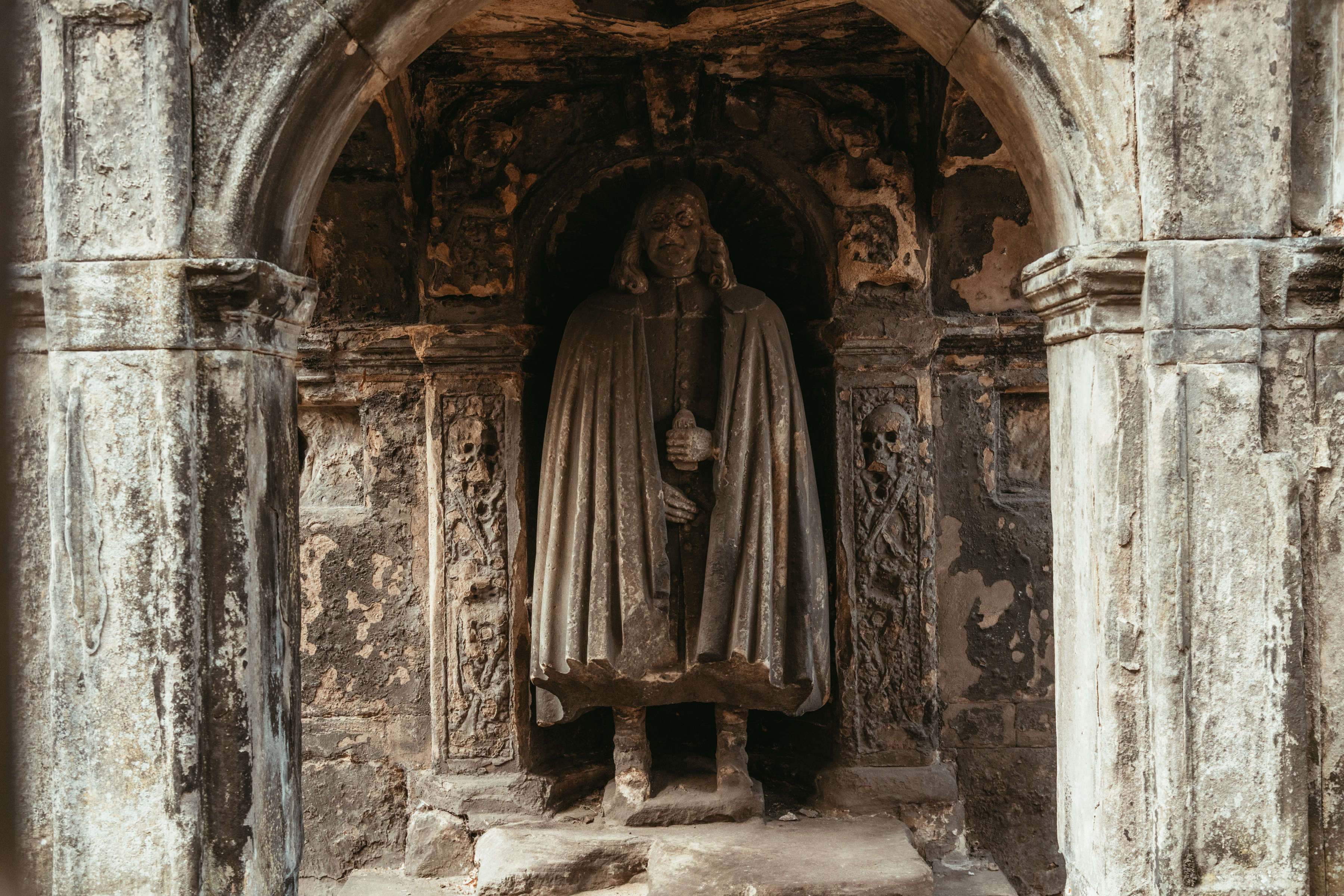
"The wonderful thing about Greyfriars Kirkyard is how many dimensions there are to it – including the 'other dimension' – from literary inspiration to tales of canine loyalty (when Harry met Bobby). I like to stop at the mausoleum of John Bayne of Pitcairlie, a prominent lawyer (or a 'writer' in Edinburgh-speak) who died in 1681. It’s such an interesting tomb, with a life-size statue of Bayne in a cloak, clutching the King’s Seal, looking not unlike Benjamin Franklin embarking on a journey to Mordor. Once ornately painted and gilded, weeds now grow around John Bayne, earth covers the heavy tombstone, and the occasional rat peeps at you from the gaps in the wall. Tempus fugit."
— Jenny Litster, Context Expert, Edinburgh
Greyfriars Bobby
The most visited grave at Greyfriars isn't a person's.
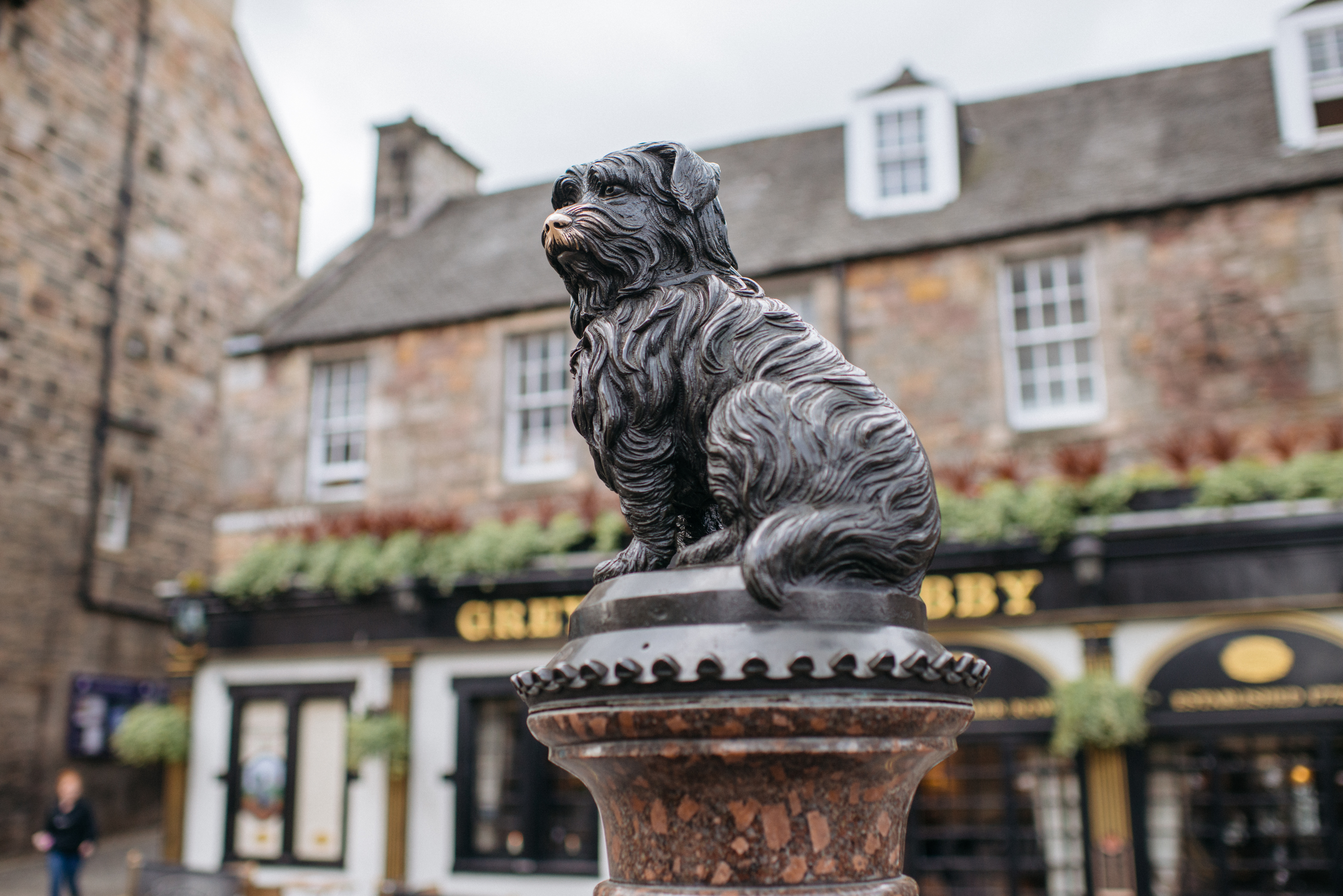
Bobby was a Skye terrier who belonged to John Gray, a night watchman with the Edinburgh City Police. Gray died in 1858 and was buried in the kirkyard. As the story goes, Bobby stayed at or near the grave for fourteen years, until his own death in 1872. Because the ground was consecrated, a dog couldn't be buried in the cemetery proper, so his headstone sits just inside the main gate near Gray's grave, and a bronze statue of him stands on the corner outside.
The details are hard to verify and several versions circulate. Some historians have argued the dog was fed and looked after by locals, and that the story was shaped considerably by Victorian sentiment and newspaper coverage. It's become one of Edinburgh's most durable narratives regardless, and it's a useful counterweight to everything else in this place.
One request: please don't rub the statue's nose. There's no historical basis for the habit, it's a recent invention, and it's stripping the bronze. The older tradition is to leave a stick at the grave.
The Harry Potter connection
George Heriot's School sits directly beside the kirkyard, and its four-house structure and turreted profile are widely cited as an influence on Hogwarts. J.K. Rowling wrote parts of the early books in cafés a few minutes' walk away.
Visitors also come looking for the grave of Thomas Riddell, which does exist here and does bear that exact name. Whether Rowling took it from the stone has never been established, and she hasn't confirmed it. File it as a good story rather than a fact, which is a reasonable posture for most things at Greyfriars.
So is it really the most haunted graveyard in the world?
We asked Jenny whether Greyfriars deserves the title, and she points somewhere else entirely.
"If ghosts in the city of the dead are frightening, those in the city of the living are worse! As early as 1685 stories of apparitions in Mary King’s Close appeared in print, only forty years after the narrow alley had been quarantined during one of the last outbreaks of bubonic plague. Today it is accessible to the public as a five-star visitor attraction … despite the fact that it was covered by buildings in the 1750s. I first visited the underground chambers when the urban legends about Edinburgh’s 'most haunted street' were at their height and it was the setting for a play about Bluebeard, with murdered wives positioned in the maze of rooms."
— Jenny Litster, Context Expert, Edinburgh
Visiting Greyfriars Kirkyard
Cost and access. Free and open to the public. The Covenanters' Prison section is locked and can only be entered on a licensed guided tour.
When to go. Early morning and late afternoon are the quietest. The kirkyard is at its best in fall, in mist, or right after rain, when the stone darkens and the whole place reads differently. Winter afternoons give you the low light and almost nobody there.
How long. Half an hour covers Bobby's grave and the main path. An hour and a half with someone who knows the grounds gets you the Covenanter's Prison, the mortsafes, the Adam monument, and a sense of why any of it matters.
Seeing Greyfriars with a historian
Most tours of Greyfriars are built around the poltergeist. Context's Edinburgh Darkside Tour: Witches and Scottish Lore does something different. It treats the ghost stories as historical evidence rather than entertainment, and asks why Edinburgh needed them in the first place.
The three-hour walk starts at St Giles' Cathedral with the Reformation, and the strange question of what happens to ghosts when a country changes its theology. It moves down the Royal Mile through the Old Town and the stories attached to Mary King's Close, into Greyfriars for Mackenzie and the Covenanters, and finishes at the National Museum of Scotland with the physical objects — the Arthur's Seat coffins, a witch's bridle — left behind by a world where believing in the supernatural had legal and lethal consequences.
No staged scares, no actors. A historian, the documented record, and a conversation about why these stories lasted.
When asked which story Jenny looks forward to telling most, it isn't the poltergeist.
"It’s certainly not one for children, but the story of Major Thomas Weir has everything of the 'dark' about it – strange religious sects, possessed walking sticks, incest, the occult, indecency, and the devil himself in a fiery coach. Weir, the 'Wizard of the West Bow', was the last man executed for witchcraft in Scotland, and one of the inspirations for Robert Louis Stevenson’s Dr Jekyll and Mr Hyde."
— Jenny Litster, Context Expert, Edinburgh
Browse all Edinburgh tours with Context Travel.
Featured Expert - Jenny Litster
Jenny grew up in the Scottish Borders before moving to Edinburgh in the late 1980s to study History and English Literature. She went on to earn a PhD from the University of Edinburgh, exploring the Scottish influences and context surrounding Canadian writer L.M. Montgomery, and later taught American History at the university.
Her career also took her into adult education research and policy, including more than a decade with the Institute of Education in London. While based in Edinburgh, she traveled frequently throughout Europe. Her particular interests include Scottish literature, folklore and cultural history, as well as children’s literature. Jenny is also the mother of two daughters.