Somewhere beneath 46 meters of Mediterranean water off western Sicily, a Roman wine shipment has been waiting for more than 2,000 years.
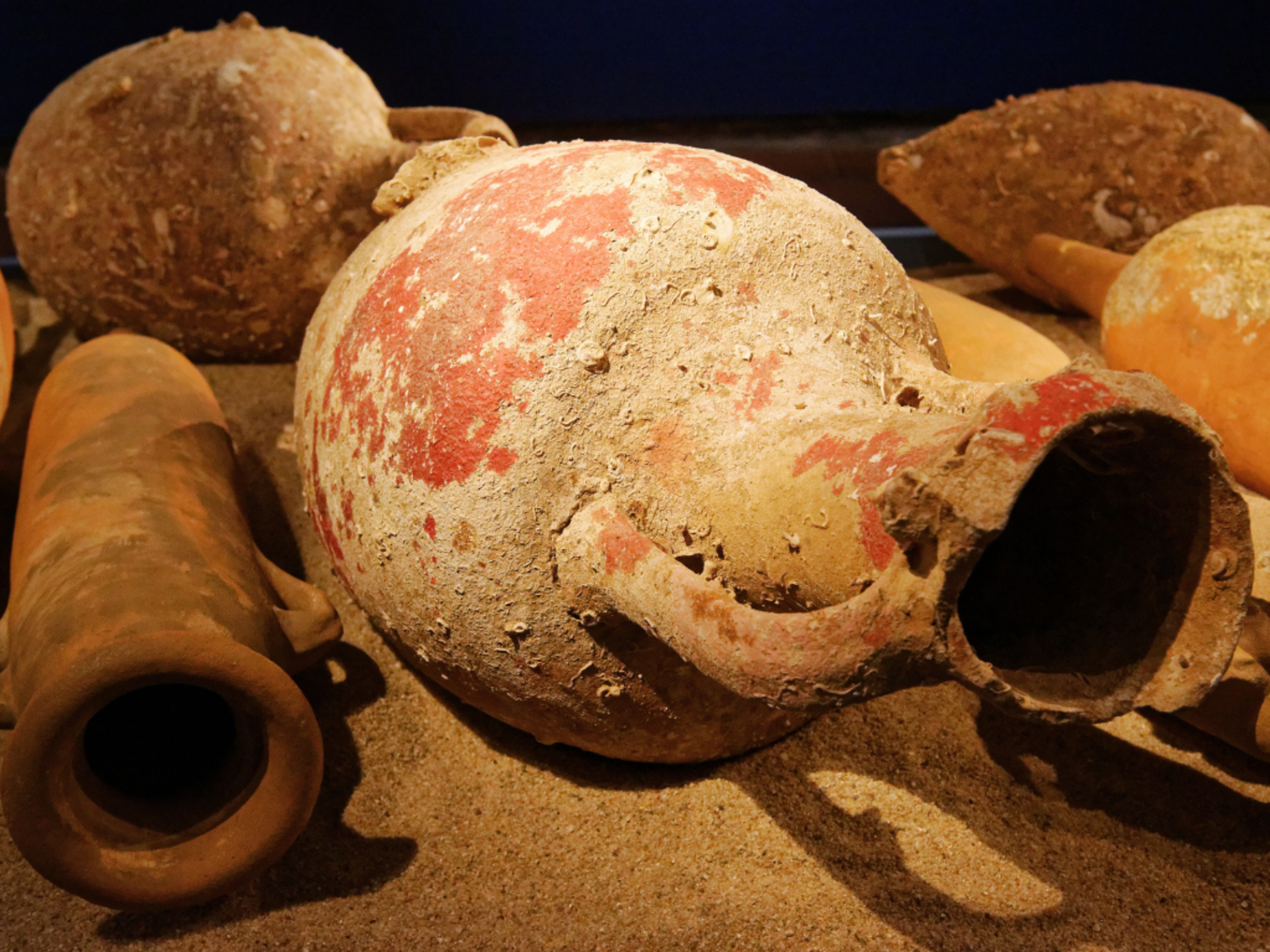
Archaeologists have confirmed the discovery of an ancient shipwreck roughly three miles off the coast of Mazara del Vallo, on Sicily's western edge. The vessel is thought to date from between the second and first centuries BCE and lies surrounded by hundreds of remarkably preserved amphorae—the ceramic containers that moved wine, oil, and other commodities around the ancient Mediterranean.
Italy's Ministry of Culture has called it one of the most important underwater archaeological discoveries of recent years.
And it's easy to see why. This shipwreck is a snapshot of a Mediterranean in motion: ships crossing between Italy, North Africa, Spain, and beyond; estates producing wine for distant markets; sailors navigating one of the ancient world's busiest commercial networks.
And Sicily sat almost exactly in the middle of it.
What Was Found Off the Coast of Sicily?
The wreck was identified near Mazara del Vallo after information from local fishermen led authorities to investigate the area. Specialist divers from Italy's Carabinieri, working with Sicily's Soprintendenza del Mare, documented the site on the seabed.
What they found was striking: hundreds of amphorae clustered together with two lead anchor stocks and another lead structure associated with the vessel.
Most of the containers have been identified as Dressel 1A amphorae, a form particularly associated with the transportation of wine during the late Roman Republic.
That detail helps archaeologists provisionally date the wreck to somewhere between the second and first centuries BCE, roughly 2,100 years ago.
Further archaeological work is expected to study the cargo, determine its origins, understand the vessel's route, and establish how much of the wooden hull might survive beneath the sediment.
First Things First: What's an Amphora?
Think of an amphora as the shipping container of the ancient Mediterranean. These tall ceramic vessels had two handles, narrow necks, and often pointed bases. They could be packed tightly together inside the hull of a ship, sometimes supported by racks and other packing material to stop them from shifting as the vessel crossed rough seas.
Their contents varied. Olive oil, fish sauces, grain, and other products traveled in amphorae, but the Dressel 1A vessels found near Mazara del Vallo are particularly associated with wine.
Examples of these amphorae have been found across the western Mediterranean and into regions that are now France, Spain, and North Africa. A broken ceramic jar might not sound especially glamorous, but to an archaeologist it can work rather like a barcode. Its shape, clay, markings, and contents can reveal where a commodity came from, when it traveled, and potentially where it was going.
So Where Was All That Wine Going?
For now, that's one of the most interesting unanswered questions.
The ship sank off southwestern Sicily, a position that places it close to routes connecting the Italian peninsula with North Africa and the western Mediterranean.
Maritime archaeologists have suggested that further investigation could help establish whether the ship was traveling toward North Africa, Spain, or elsewhere. But until the cargo is studied more closely, its precise journey remains a possibility rather than a conclusion.
Where was the cargo produced? Who owned it? Which port had the vessel left? Where was it headed? Was the voyage routine, or part of an emerging trade route? These are questions still to be answered.
Why Sicily Matters
The island sits between mainland Italy and North Africa, with the eastern and western Mediterranean stretching away on either side. For millennia, that geography has made Sicily a crucial meeting point.
Phoenicians settled its western shores. Greek colonists established powerful cities including Syracuse and Akragas, modern Agrigento. Rome took control of Sicily after the First Punic War in 241 BCE, making the island its first province outside the Italian peninsula. Agriculture, taxation, ports, and shipping subsequently tied Sicily closely into Rome's expanding political and economic world.
By the period in which the Mazara del Vallo ship likely sank, Rome was changing rapidly. Its influence stretched ever farther across the Mediterranean, while trade moved commodities, people, technologies, and ideas over enormous distances.
Sicily's Seas: Key to Archaeological Discoveries
The Mazara del Vallo discovery isn't an isolated case.
Sicily's surrounding waters have become one of the Mediterranean's richest landscapes for underwater archaeology, preserving traces of trade, migration, warfare, and ordinary travel from antiquity through the modern era.
And 2026 has been a particularly busy year!
Near Lipari in the Aeolian Islands, archaeologists recently recovered the surviving hull of the Secca di Capistello wreck, a Hellenistic merchant vessel that sank in the third century BCE after striking a reef. Its cargo of amphorae had been recovered decades earlier and is held at Lipari's archaeological museum. The newly recovered hull will allow researchers to study ship and cargo together.
Off Lampedusa, archaeological work has also recovered dozens of artifacts spanning from the late Roman Republic into late antiquity. Elsewhere, Sicily's Soprintendenza del Mare is using sonar, remotely operated vehicles, and three-dimensional documentation to map archaeological sites at depths that would once have been difficult to investigate systematically.
What Happens to a Shipwreck After It's Found?
Discovering a wreck is only the beginning.
Archaeologists first need to document the site carefully before disturbing it. The position of every amphora, anchor, fragment of timber, and object can contain information about how the ship was loaded, how it sank, and what happened afterward.
Modern underwater archaeology increasingly uses photogrammetry, sonar, remote vehicles, and three-dimensional models to record sites with extraordinary precision.
Sometimes, excavating everything isn't necessarily the goal. Removing material from the seabed can expose it to rapid deterioration, particularly when waterlogged wood has survived in relatively stable conditions for centuries. In many cases, archaeologists conserve shipwrecks in situ, recovering only the objects needed to answer specific research questions.
At Mazara del Vallo, the next stage will focus on documenting the archaeological context and protecting the site while researchers work to understand it.
Other Sites to Explore Ancient Sicily Today
Agrigento and the Valley of the Temples
Long before Sicily became Roman, Greek Akragas was one of the most prosperous cities in the Mediterranean.
Today's Valley of the Temples preserves an extraordinary group of monumental Greek sanctuaries, including the remarkably intact Temple of Concordia. Standing among them puts the scale and wealth of ancient Sicily into perspective: these weren't marginal settlements at the edge of the Greek world, but ambitious cities plugged into Mediterranean networks of trade and culture.
Explore the site with an archaeologist on Context's Agrigento Archaeology Tour: Valley of the Temples.
Syracuse
On Sicily's southeastern coast, Syracuse offers another version of the story.
Founded by Greek settlers in the eighth century BCE, the city became one of the ancient Mediterranean's great powers. Greek theaters, Roman structures, temples incorporated into later buildings, and the dense historic center of Ortigia make the city's long life unusually easy to see.
The pleasure here is in realizing that the eras don't sit neatly beside one another. They have been reused, built over, absorbed, and reinterpreted for more than two thousand years.
Palermo
Palermo takes the Mediterranean-crossroads idea and runs with it.
Phoenician beginnings were followed by Roman, Byzantine, Islamic, Norman, and later periods of rule, producing a city where cultural exchange is written directly into architecture, language, street life, and food.
Context's Sites & Insights: Palermo City Tour traces those layers with a local historian, from the city's Arab-Norman legacy to the Palermo of today.
Lipari and the Aeolian Islands
For travelers particularly intrigued by shipwrecks, Lipari deserves a place on the list.
The Aeolian Islands occupied important maritime routes from prehistoric times onward, and the Museo Archeologico Regionale Eoliano preserves material recovered both on land and from the surrounding sea.
The recently recovered Secca di Capistello hull is expected eventually to join its cargo in Lipari following conservation and further study, offering a rare opportunity to reconnect an ancient merchant vessel with the goods it once carried.
A Wine Shipment, 2,000 Years Late
It's tempting to focus on the drama of the wreck itself, but the really interesting part might just be what happened before it sank.
Someone grew the grapes. Someone made the wine. Potters shaped hundreds of amphorae to carry it. Laborers packed them into a merchant vessel, and sailors set out across a sea crisscrossed by commercial routes that connected distant communities long before anyone could speak of a global economy.
Then, for reasons we don't yet know, the journey stopped off Sicily.
More than two millennia later, the cargo is helping archaeologists reconstruct the world that sent it there.
It's a useful reminder when traveling through Sicily that the island's history has never belonged to the island alone. For thousands of years, people, goods, beliefs, languages, and ideas have arrived across the water and departed again.
Sometimes, the Mediterranean gives a piece of that story back.