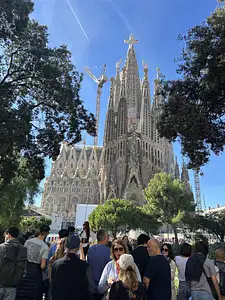
The Sagrada Família does not need to be understood room by room. Much of Gaudí’s architecture is built around recurring systems: geometry, natural forms, structural logic, light, and symbolism. Once those relationships become clear, individual details begin to make more sense.
For example, the basilica’s tree-like columns are not simply decorative references to nature. Their branching forms help distribute weight while also creating the impression of a stone forest. The same is true of Gaudí’s use of geometry.
Forms that appear organic are often highly calculated. Hyperboloids, helicoids, ruled surfaces, and branching structures allowed Gaudí to solve technical problems while creating an architecture that feels unlike conventional masonry construction.
That is why a focused visit can still be substantive. Rather than trying to see everything, the tour gives you a set of interpretive tools you can continue using as you look around the basilica yourself.