Italy has 62 UNESCO World Heritage Sites—more than any other country on earth.
Impressive? Absolutely. Useful when you're trying to plan a trip? Not necessarily.
Attempt to see the full list and you'll spend much of Italy looking out of a train window. These 62 places include Greek temples older than the Roman Republic, entire Renaissance city centers, volcanic slopes, Byzantine mosaics, villages carved into cliffs, and roughly thirty-eight miles of covered walkway in Bologna. They were never meant to form one coherent itinerary.
A better way to use this UNESCO list is as a clue.
What are you actually curious about? Maybe it's how Renaissance Florence turned banking fortunes into some of the world's most enduring art. Perhaps it's why a Greek temple still forms the bones of a cathedral in Syracuse, or how Venice managed to build a city where there arguably shouldn't be one. Maybe you want to understand why some of Italy's most famously beautiful landscapes aren't really natural at all.
Italy's World Heritage Sites become much more interesting when you use them to form a story behind your trip.
Here are our top four.
Explore UNESCO ToursIf You Travel for Art: Follow the Money
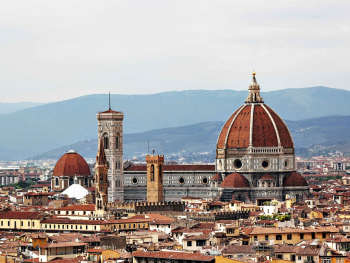
Florence is the obvious place to begin, but not simply because the Uffizi has Botticelli or Brunelleschi's dome.
The more interesting story is how an extraordinarily concentrated group of bankers, merchants, guilds, popes, and princes used art to make power visible. The Uffizi, the Bargello, the cathedral complex, and the Medici tombs were produced within one relatively small city over roughly 150 years, much of it supported by the same interconnected families.
Walk through Florence with that in mind and the Renaissance becomes less a procession of masterpieces and more a story about ambition. Who commissioned this? Who was meant to see it? What was the patron trying to say?
Go deeper in Florence: Signature Uffizi Gallery Tour · Florence Cathedral Tour: Duomo and Museum · Florence Medici Tour: Portrait of a Family
Then Follow the Story to Venice
Venice built its wealth differently. Its fortunes were tied to trade with Byzantium and the Levant, and its art shows it.
Begin beneath the gold mosaics of St. Mark's Basilica, then move forward several centuries to Titian and Tintoretto. While Florence became famous for structure and intellectual order, Venice developed its own tradition of color, atmosphere, and light.
The differences make more sense when you understand the cities that produced them.
Go deeper in Venice: St. Mark's Basilica Tour: Mosaics and Crypts · Venice Art Tour: Titian and Tintoretto · After-Hours St. Mark's Basilica Tour
Don't Skip Ravenna
Ravenna complicates the story altogether.
Its eight UNESCO-listed monuments contain some of the finest surviving Byzantine mosaics outside Istanbul, created in the 5th and 6th centuries when Ravenna was capital of the Western Roman Empire.
The scale is often surprisingly intimate. Step inside the Mausoleum of Galla Placidia and a small brick exterior gives way to a deep blue ceiling scattered with gold stars. It's a useful reminder that the story of Italian art began long before the Renaissance.
Go deeper: Ravenna Day Trip from Bologna: UNESCO Mosaics
One Masterpiece Worth Building Around
In Milan, Santa Maria delle Grazie holds a UNESCO designation closely associated with one work: Leonardo da Vinci's The Last Supper.
Leonardo painted it using an experimental technique that began deteriorating within his own lifetime. What survives today is not simply a Renaissance masterpiece, but the result of centuries of preservation and restoration. Viewing is tightly controlled, with small groups admitted for short time slots.
Go deeper: Milan da Vinci Tour: The Last Supper
Build the trip: Florence → Venice → Ravenna, with Milan as an easy addition
Best for: art lovers, museum-goers, photographers, and anyone curious about how money and power shape culture
Ideal length: 8–12 days
If You Travel for History: Look Beneath the Surface
In Italy, history doesn't disappears... It gets built over.
A Baroque church may stand on a medieval foundation laid over a Roman temple. A Christian cathedral may incorporate the columns of a Greek sanctuary. A modern road may follow a route first paved more than two thousand years ago.
For travelers interested in history, the most rewarding UNESCO sites are often the ones where several periods occupy the same ground.
Start in Rome
Rome has been continuously rebuilt for more than two thousand years. The Colosseum and Roman Forum may anchor the ancient city, but they are only one layer.
The more revealing question is often: what was here before?
Churches reuse Roman columns. Medieval buildings incorporate ancient foundations. Renaissance palaces rise beside imperial ruins. Rome rewards anyone willing to look vertically as well as chronologically.
Go deeper in Rome: Complete Colosseum Tour: SUPER Sites & Arena Floor · Underground Rome Tour: From Empire to Middle Ages · Ancient Rome Tour: Daily Life of Everyday Romans
See Roman Life Interrupted at Pompeii and Herculaneum
When Vesuvius erupted in 79 CE, it preserved two Roman towns at the moment their everyday lives stopped.
That's why Pompeii and Herculaneum are so compelling. Beyond temples and villas, there are painted shop signs, graffiti, food, furniture, streets, kitchens, and traces of ordinary domestic life that survive almost nowhere else.
Herculaneum is smaller and, in places some better preserved, with wooden architectural elements and upper floors still standing. Seeing both gives you something neither can provide alone: a sense of how different Roman communities actually functioned.
Go deeper: Pompeii and Herculaneum Day Trip from Naples · Pompeii Full-Day Trip from Rome
Walk Out of Rome on the Appian Way
The Via Appia joined the UNESCO list in 2024, but Romans began building it in 312 BCE.
Stretching from Rome toward Brindisi, the road connected the capital to southern Italy and the wider Mediterranean. Just beyond Rome, stretches of ancient basalt paving survive alongside tombs and funerary monuments. Roman law prohibited burial within the city walls, so the roads leading outward became landscapes of remembrance.
Go deeper: Appian Way & Catacombs Day Trip from Rome
Go Further Back
In Sicily, the historical timeline changes again.
The Valley of the Temples at Agrigento preserves monumental Doric temples built in the 5th century BCE, when the city known as Akragas was one of the great Greek centers of the Mediterranean. The Temple of Concordia survived unusually intact in part because it was later converted into a Christian church.
In Syracuse, the layering becomes even more literal. On Ortigia, the cathedral was built directly into a 5th-century BCE Greek temple. Its ancient Doric columns are still visible within the walls.
Go deeper in Sicily: Agrigento Archaeology Tour: Valley of the Temples · Sites & Insights: Syracuse City Tour · Ortigia Sunset Tour: Syracuse & Wine
Build the trip: Rome → Naples → Pompeii and Herculaneum → Sicily
Best for: historians, archaeologists, educators, and travelers who enjoy seeing one era layered over another
Ideal length: 10–14 days
If You Travel for Architecture: Look at the Problem Each City Had to Solve
Some of Italy's most interesting architecture makes more sense when you stop asking whether a building is beautiful and start asking why it had to be built that way.
Different cities faced different constraints: not enough space, unstable ground, political competition, earthquakes, defensive needs, or the challenge of projecting power.
The solutions became part of their identities.
Give Bologna More Room
As Bologna's population and university grew, the medieval city needed space.
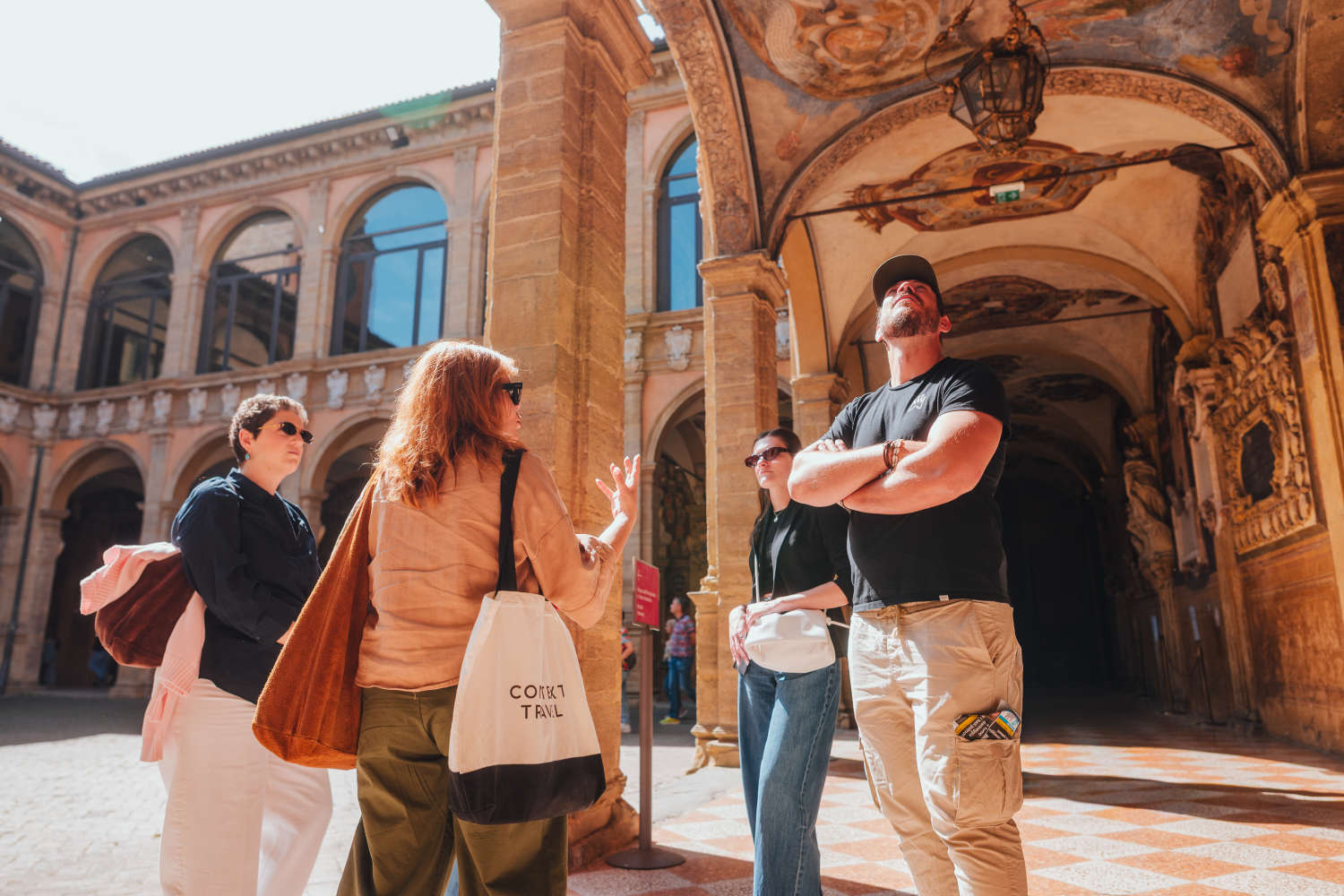
Buildings expanded outward above the street, with upper floors supported by columns below. What began as a practical response eventually produced one of Bologna's defining features: a vast network of porticoes that blurs the boundary between the public street and the private building above it.
Today, the UNESCO-listed system stretches for roughly thirty-eight miles. The Portico di San Luca alone runs for around two and a half miles, climbing from the city toward the Sanctuary of the Madonna di San Luca beneath hundreds of arches.
Go deeper: Sites & Insights: Bologna City Tour · Bologna In a Day Tour
Venice's Land Problem
Nearly every architectural decision in Venice begins with the lagoon.
The city stands on timber piles driven into waterlogged ground. Palaces, churches, warehouses, and neighborhoods rose on foundations created where solid land was in short supply.
The Byzantine, Gothic, and Renaissance facades lining the canals are spectacular, but understanding the engineering beneath them makes the entire city stranger and more impressive.
Go deeper: Venice Architecture Tour: Palaces and Canals · Doge's Palace Tour
Southeastern Sicily Had to Start Again
In 1693, a catastrophic earthquake devastated much of southeastern Sicily.
Eight towns in the Val di Noto were subsequently rebuilt on an extraordinary scale. The result is one of Europe's most coherent late Baroque landscapes. Visit with an expert to understand the significance behind planned streets, theatrical staircases, honey-colored limestone, and facades meant to showcase certain meanings as you move through the city.
Noto and Modica are especially revealing because their architecture responds not only to taste, but to topography. Buildings appear, disappear, and dramatically re-emerge as streets climb through the hills.
Go deeper: Sites & Insights: Noto City Tour · Sites & Insights: Modica City Tour · Catania Highlights Tour
Palermo Became a Meeting Point
Architecture can also preserve cultural exchange.
In 12th-century Sicily, Norman rulers governed a society in which Arabic, Greek, Latin, and Hebrew all played roles in public life. The churches and palaces of Palermo, Cefalù, and Monreale reflect that world.
Islamic architectural forms sit alongside Byzantine mosaics within Christian buildings. At Monreale Cathedral, vast expanses of gold mosaic transform the interior into something that feels at once European and Mediterranean.
Go deeper: Palermo In a Day Tour: Markets and Monreale · Sites & Insights: Cefalù City Tour
Also Worth Building Into the Trip
Verona: A city where a Roman arena, medieval street plan, and Renaissance fortifications reveal how one urban footprint adapted across roughly two millennia. Sites & Insights: Verona City Tour · Verona In a Day Tour
Genoa: The Palazzi dei Rolli were built by the city's ruling families and registered to host visiting dignitaries, turning private wealth into a form of civic hospitality. Sites & Insights: Genoa City Tour
Pisa: Look beyond the Leaning Tower. UNESCO protects the Piazza del Duomo as a complete composition of cathedral, baptistery, campanile, and cemetery. Sites & Insights: Pisa City Tour · Lucca and Pisa Day Trip from Florence
Build the trip: Bologna → Venice → Verona, or head south through Sicily's Baroque and Arab-Norman cities
Best for: architects, designers, engineers, urbanists, and anyone who enjoys asking why cities look the way they do
Ideal length: 9–12 days
If You Travel for Landscapes: Question What Looks Natural
Some of Italy's most photographed landscapes look effortless.
They aren't!
Terraces, cypress-lined roads, vineyards, hill towns, lemon groves, and even apparently untouched countryside often represent centuries of deliberate human intervention.
That is precisely why several of these places are UNESCO World Heritage Sites.
Start in the Val d'Orcia
The Val d'Orcia looks almost impossibly composed: rolling fields, rows of cypress trees, stone farmhouses, and hill towns positioned exactly where a painter might want them. Did you know there's a reason for this?
The landscape was reshaped during the 14th and 15th centuries under Sienese rule according to ideas about agricultural productivity, beauty, and good government. Later Renaissance painters helped turn that cultivated landscape into an ideal.
Pienza, within the valley, took the experiment further. This medieval town was deliberately redesigned during the 15th century according to Renaissance humanist principles.
Go deeper: Val d'Orcia Day Trip from Florence: Pienza & Wine · Val d'Orcia Day Trip from Siena
Then Look More Closely at the Cinque Terre
From a distance, the Ligurian coast appears impossibly romantic with its villages wedged between steep green hills and the sea.
Up close, you begin to see the infrastructure.
For generations, residents built dry-stone walls across near-vertical slopes, creating terraces where grapes, olives, and other crops could grow. The landscape UNESCO protects is therefore not untouched nature; it's the cumulative result of centuries of physical labor.
Go deeper: Cinque Terre Day Trip from Florence · Cinque Terre Day Trip from Genoa
The Amalfi Coast Tells a Similar Story
The Amalfi Coast is UNESCO-listed as a cultural landscape, not simply because it is beautiful.
For centuries, communities shaped its difficult terrain into something habitable and productive. Lemon groves, vineyards, towns, paths, and terraces cling to steep rock above the Mediterranean.
Even Amalfi's history as an independent maritime republic is written into the landscape and architecture, where connections with Byzantium and the eastern Mediterranean remain visible.
Go deeper: Sorrento and Amalfi Coast Day Trip from Naples · Pompeii and Amalfi Coast Day Trip from Naples
On Etna, the Landscape Is Still Being Made
Mount Etna offers a very different relationship between people and place.
Europe's most active volcano has one of the world's longest documented histories of volcanic activity. Communities continue to farm its slopes despite that volatility, in part because volcanic soils support distinctive vineyards and agriculture.
Here, the landscape isn't simply something inherited from the past. It is still changing.
Go deeper: Full-Day Mount Etna Day Trip with Wine Tasting · Half-Day Mount Etna Day Trip
And Sometimes the Landscape Is Quite Literally Designed
At Villa d'Este in Tivoli, a 16th-century cardinal transformed a hillside into a vast experiment in water, engineering, perspective, and theatricality.
Its fountains operate through gravity, sending water through a garden that would influence generations of European landscape design.
Versailles came later.
Go deeper: Tivoli Day Trip from Rome: Villa d'Este & Gardens
Add Siena and San Gimignano
Siena and San Gimignano offer another way to see the relationship between town and landscape.
Siena's medieval urban form gathers around the Piazza del Campo, while San Gimignano's surviving tower houses rise from the Tuscan countryside as remnants of a medieval competition for status expressed vertically in stone.
Go deeper: Siena Highlights Tour: Duomo & Palazzo Pubblico · San Gimignano and Siena Day Trip from Florence
Build the trip: Tuscany → Liguria → Amalfi, or explore Sicily through Etna and its surrounding towns
Best for: walkers, photographers, food and wine travelers, and repeat visitors looking beyond individual monuments
Ideal length: 10–14 days
One More: Italy's Newest UNESCO Site
One of Italy's newest UNESCO stories isn't a grand cathedral, archaeological site, or famous landscape.
It's a network of theaters.
Ten Italian-style condominio theaters across Emilia-Romagna, Marche, and Umbria joined the World Heritage List in July 2026.
Their significance lies in more than ornate boxes, historic stages, and surviving theater machinery. The condominio model allowed municipalities and private citizens to share ownership, helping small and medium-sized towns build sophisticated theaters of their own.
The result was a cultural network in which opera and performance were not reserved only for the largest capitals.
It's exactly the sort of UNESCO designation worth paying attention to: not because the places are already famous, but because the designation gives us a new reason to notice them.
So, Which UNESCO Sites in Italy Should You Actually Visit?
Not all 62.
That is rather the point.
A UNESCO designation can tell us that a place has extraordinary value. It cannot tell us which history will stay with you after you come home.
An art lover might spend days following the Medici through Florence and never reach Pompeii. An architect could build an entire trip around Bologna, Venice, and the rebuilt Baroque towns of Sicily. Someone fascinated by the relationship between people and landscape might barely set foot inside a museum.
None of them would be doing Italy incorrectly.
Choose the question you want the trip to answer. Follow it from city to city. Leave a few famous places for another time.
Italy is very good at rewarding unfinished business.
Browse Context Tours Across Italy
Frequently Asked Questions
How many UNESCO World Heritage Sites are in Italy?
Italy has 62 UNESCO World Heritage Sites as of 2026, the highest total of any country. The total can change when the World Heritage Committee adds new properties to the list.
Which country has the most UNESCO World Heritage Sites?
Italy currently has the largest number of UNESCO World Heritage Sites, with China close behind.
Are all of Italy's UNESCO sites cultural?
No. Most are cultural sites, but Italy also has natural World Heritage Sites including Mount Etna, the Dolomites, and the Aeolian Islands. Places such as the Val d'Orcia and Amalfi Coast are recognized as cultural landscapes because their significance comes from the relationship between people and the natural environment.
What is Italy's newest UNESCO World Heritage Site?
Among Italy's newest additions is the system of Italian-style condominio theaters of the 18th and 19th centuries in Central Italy, a group of ten historic theaters across Emilia-Romagna, Marche, and Umbria inscribed in 2026.
Can you visit Italy's UNESCO sites without a guide?
Most can be visited independently. Some sites have timed or restricted entry, while others are simply difficult to understand without context. At places such as Pompeii, the Vatican Museums, or the historic centers of Rome and Florence, the challenge is rarely finding something to see. It's understanding how the pieces fit together.
What's the best way to plan a trip around Italy's UNESCO sites?
Rather than trying to visit as many as possible, choose a theme that genuinely interests you — art, archaeology, architecture, landscape, religion, or another thread — and build the itinerary around places that deepen that story. You'll usually come away with a stronger sense of Italy than you would from simply collecting famous landmarks.